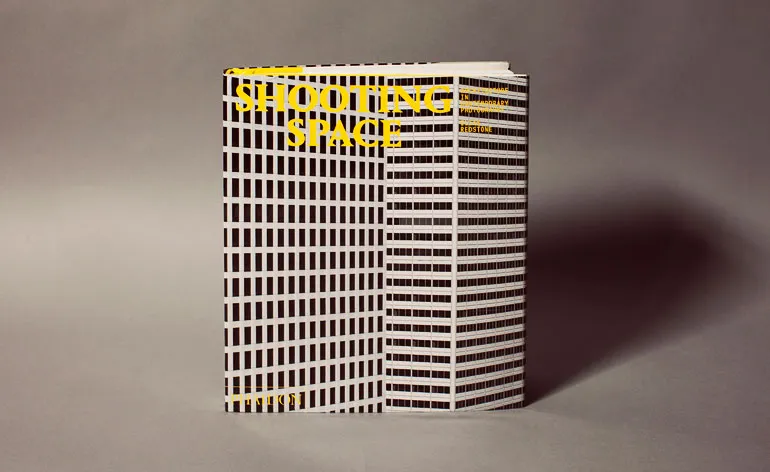
An art exhibition that inspires a companion monograph is something viewers have come to expect. A monograph that inspires a blockbuster exhibition is another story, however.
Yet that's how author Elias Redstone came to curate the Barbican's successful architectural-photography show Constructing Worlds. Redstone was deep into the research of his stunning new volume Shooting Space when the Barbican tapped him for what eventually became 'Constructing Worlds'. The exhibition is on now through early January. The book - like the complex architecture it flaunts - was built to last.
Photographers have been 'shooting space' since the birth of the medium - no other subject would have stood still long enough to satisfy the long exposures. What makes Redstone's tome even more rare is its focus on the relationship between architecture and photography in an age of rapid urbanisation, from the perspective of the artist. The voices are as varied as Catherine Opie, who favours concrete cityscapes, Geert Goiris, who captures abandoned utopias, and Armin Linke, who explores politicised spaces - not to mention Iwan Baan, Michael Wolf and Andreas Gursky.
According to Redstone, the genre truly came of age in the midcentury, when photographer Lucien Hervé presented Le Corbusier's Indian architecture to the world. Shooting Space is the natural successor of that era. What connects the 50 photographers featured here is their portrayal of architecture as a symbol for how we live, a literal window to our soul.
In an accompanying essay called 'Coming of Age', architect Pedro Gadanho suggests their work is a legacy of the New Topographics movement of the 1970s, when man's relationship with nature was documented against industry and urban sprawl. 'The artists' work is beautiful even when they're looking at ugliness or banality or sites of neglect or dereliction,' he says.
Shooting Space includes some of the best photographers working today, yet the architecture is the protagonist, rising above the so-called 'architecture porn' we're all accustomed to and finding a fresh, authentic voice.
Gadanho compares the photographers with painters of the 19th century. 'Confronted with photography, painting had to give up on its ambitions of producing a realistic portrait of reality, thus moved forward to new expressive realms,' he says. 'Confronted with digital renderings… architectural photography also seems to need to move beyond its traditional status as a mere tool in the neutral, realistic representation of architecture.'

Thomas Weinberger creates his artwork by digitally arranging daytime and nighttime versions into a single image in order, says Redstone, to 'challenge the definition of photography as only capable of capturing one moment in time.' In 'Cracker' (2003), Weinberger captures a German Esso refinery

'Bildraum S 130' (2006) is one of a series of photographs by Walter Niedermayr, capturing the work of the Japanese architecture practice SANAA. 'His works are typically presented as diptychs presenting a single impression of space,' says Redstone, 'while implying a sequence and a shift in perspective'

The Bruder Klaus chapel in Mechernich, Germany, designed by Peter Zumthor, was photographed by Hélène Binet in 2009

Binet's depiction of light and shadow references Lucien Hervé, one of the early greats of architectural photography. Here she captures Zaha Hadid's Phaeno Science Centre in Wolfsburg, Germany, in 2005

Bas Princen's 'Superior Court' and 'Ringroad (Houston)', both photographed in 2005

Photographer James Welling documented Philip Johnson's Glass House between 2006 and 2009, placing coloured filters in front of his digital-camera lens to create a psychedelic effect

Frédéric Chaubin's fascination with late Soviet-era architecture is seen here in his 2006 photograph of the Druzhba Sanatorium, incongruous within the pastoral of Yalta, Ukraine

An abandoned Red Army bunker in Liepaja, Latvia, by Geert Goiris

Filip Dujardin reconfigures visual elements to create surreal constructions, like this work from his 2007-11 'Untitled' series