Arch4
With studios in Moscow and Basel, ARCH4 are branching out confidently with projects outside of Russia. Set up in 1996, the studio makes much of its ability to synthesise Russian identity with the country's ongoing predilection for 'European-style' quality. The Russian landscape is a particular inspiration, and ARCH4's team pick up bits and pieces from every aspect of the country's past and present - from rigorous woodwork through to repurposed industrial machinery. From early projects like the proto-high tech chrome and glass fest of their first project, the Jet Plane Flat, through to recent houses in the forested landscape around Moscow, the emphasis is on craft and quality, seeking out levels of surface finish that they claim simply don't exist in contemporary Russian culture. This quality-led approach has also given the firm a shot at boutique-building for established brands like Hermès, Louis Vuitton and Ferragmo in Moscow's Stoleshnikov Lane. Hermès has even taken ARCH4 to Basel.
www.arch4.ruWriter: Jonathan Bell
Archpole
Based in Moscow, Archpole was launched in December 2008 by partners Anna Sazhinova and Konstantin Lagutin. Both graduates of the Moscow Architectural Institute with degrees in urbanism and residential architecture respectively, Sazhinova and Lagutin share an experimental design and production style that aims to transcend scale; the team applies their unique approach to both architectural space as well as the objects within it. 'For the moment, Archpole are in the endless process of flying towards new horizons,' they admit. Their upcoming work includes a few larger-scale projects such as a pine-tree log vacation house and a hostel structure for the next Arhstoyanie festival in rural Russia. At the same time, the group continues to take on numerous interior projects, both residential and commercial. One of their most important endeavours so far is undoubtedly their own showroom, set to be launching alongside their virtual store this December in celebration of the practice's 4th birthday.
www.archpole.ru
Writer: Alex Garkavenko
Atrium
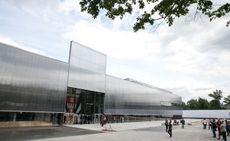
Located in the heart of Moscow and working with a range of scales, from interior pieces tourban plans, the studio of Atrium consists of founders Anton Nadtochiy and Vera Butko and their team of 50 employees. Since 1994, they have been involved in projects that span private interiors, offices, retail, recreational, social and public spaces, and they are now venturing increasingly into the urban scale. 'Everything we ever design is architecture, and it doesn't matter if it is a table, or a high-rise,' they explain. Atrium reveals that much of their design is driven by a 'formal approach to architecture and demonstrating bold spacious experiments in real design'. For example, their Gorky project draws much from the shape of a folded airplane. Atrium is also heavily inspired by 'green technologies', having received multiple awards for eco-friendly design. Their distinctions include a recent presence at the
Venice Architecture Biennale, where they showcased their townhouse area for techno park district D2 in Skolkovo.
www.atrium.ru
Writer: Alex Garkavenko
Bureau Praktika
Architectural Bureau Praktika was established as recently as 2009, by partners Denis Chistov, Anastasia Glukhova and Grigory Guryanov. They currently lead a team of five from their central Moscow base. "For the first 3 years of our practice we've been working at formulating our principles of meaningful and responsible architecture", they say. "We're looking for solutions that are both rational and efficient". The CoWorking creative office cluster is their most recent work, a workspace project for sole practitioners and small start-up companies at the Design-Zavod Flacon factory in Moscow. While each individual is given their own office base, facilities such as meeting rooms, printers and the Internet are shared. The architects may have not had unlimited budget to play with - choosing simple materials and an overall industrial feel for the space as a result - but they still feel it is their most successful project so far. 'We consider it to be the most consistent realization of our design principles', they say.
www.bureau-praktika.ruWriter: Ellie Stathaki
Mossine Partners
With offices in both Moscow and Berlin, architect Anton Mossine along with business partner Ullrich Jasper, have collaborated under the name 'Mossine, Jasper & Partners' from 1998, and 'Mossine Partners' since 2008. While admitting that he was once very influenced by the work of the Modernists of the 20th Century - known for their austere and wilful works - Anton Mossine is now more 'intrigued by the subject of nomadic, movable and mobile architecture', a concept that took form (even if ephemerally) in their recent inflatable structure project. Set-up for a real estate office in Moscow earlier this year, the soft enclosure encompasses a cheeky reference to the migratory process that the clients themselves are undergoing, referencing the properties they are purchasing, which may themselves not yet be in existence. A similar playful approach is sustained through the rest of their projects too - many of which are residential.
mossinepartners.com
Writer: Alex Garkavenko
Tsimailo Lyashenko
After studying together at the Moscow Architectural Institute, Alexander Tsimailo and Nikolay Lyashenko first joined forces in 2001, leading to the founding of Moscow-based studio Tsimailo Lyashenko & Partners in 2005. With a large array of projects already under their belts, including residential, commercial, religious, and hospitality ones, the team likes to approach each project differently, saying that 'the process of designing is [their] main source of inspiration'. This open outlook has helped them create everything from intimate private spaces (sensitive to the natural surroundings), to public works inspired by social conditions. 'Each project is a task with an infinite number of solutions. In our opinion the search for the most accurate of them is an exciting process, linking a combination of a huge amount of different disciplines,' they say, stressing the importance of context to their designs. Having contributed to the Russian Pavilion in Shanghai in 2010 and designed a tourist and hotel centre in Sochi in preparation for the forthcoming Olympic games, they still take as much pride in their smaller projects, where something as subtle as framing the landscape can drive the design process.
www.tlp-ab.ru
Writer: Alex Garkavenko
XYZ
It was early 1998 when architect Svetlana Golovina set up her studio, XYZ, in Moscow. The practice remains small, with a fluctuating number of employees to suit the office's workload at each time. XYZ uses many different sources for its architectural inspiration, from nature, everyday life and encounters and debates with friends, to the work of fellow architects, and a specific place or material. Its most recent work includes a small vacation house, sitting not far from Moscow by the beach at the Kliasminskoe reservoir. Making the most of the wooden 130sqm structure's waterside location, the architects designed each space open towards the reservoir, adding an eye-catching façade of mixed wood and green Plexiglas. A second project that counts among the practice's favourites is the renovation of a historical street in the Ural city of Perm. Adding new landscaping elements and contemporary housing to a period environment was no easy task, but the team responded by designing a series of thoughtful metal buildings that cleverly completed the nearby historical house's outline and modern Plexiglas street furniture that brought the street subtly into the 21st century.
www.xyz-arch.ru
Writer: Ellie Stathaki
Za Bor Architects
Founded by Peter Zaytsev and Arseniy Borisenko in 2003, Za Bor has always kept itself small, despite the many projects on the boards. Since it was set up, the studio has completed some 60 projects, receiving widespread acclaim for its private houses, offices and more. The partners travel extensively. 'Each place has its own silhouette, form and nature, and each is unwittingly transmitted into our other projects,' they say. 'We're trying to improve our local environment for future generations - that's the driving and decisive force of our creative work.' Current projects include the Moscow outpost of the Badoo social network, with some typically bold and brash dotcom-office stylistic traits, and the 'Parasite office', an abstracted volume slotted in between two existing buildings and designed for the practice's own use during a recent refurbishment. The 'House of Mr R' winds past existing trees, its massing comprised of interlocking grey forms.
za-bor.net
Writer: Jonathan Bell
Tweet this
Share this on Facebook