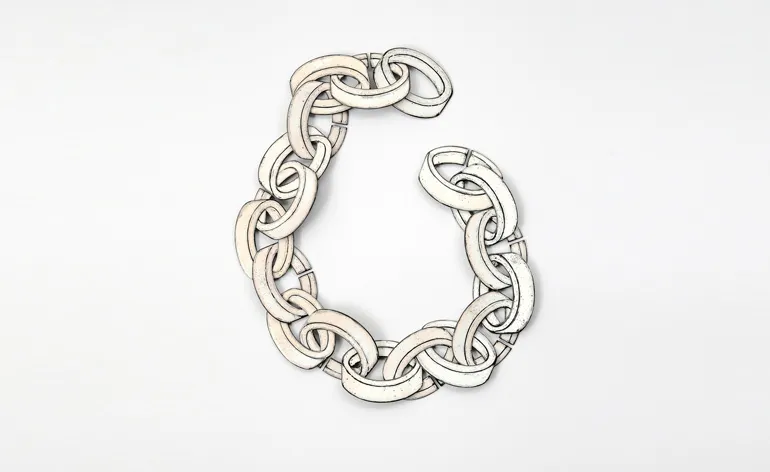
It may be in its 55th year but Schmuck, the world's premier contemporary jewellery show, which takes place at the International Crafts and Trades Fair in Munich, has an outlook that is fresher than ever.
An emphasis on youth and youthfulness - of both exhibitors and visitors to this year's event - means that the fair and indeed Munich are still setting the tone for the international art jewellery scene. That is only made possible because of the presence of art-jewellery greats, whether in person or via their works, that are the pivot of the week long celebration of the genre.
Both the fair and the satellite exhibitions in and around Munich's gallery district succeed because of a well curated mix of both established and new artists. Exhibiting significant works by the likes of Dorothea Prühl and Warwick Freeman acts as a distinct reference point to the work of younger artists, making sense of a genre that is always in danger of coming across like a mish mash of small-scale conceptual art.
This year's highly colourful narrative manifested itself in a fresh take on fabrics such as plastic, steel, polyurethane, acrylic and concrete. It was a bold move away from traditional organic forms and materials, such as wood, natural textiles and bone, although that strong connection with landscape and environment was still well represented.
Schmuck's new energy must in part be attributed to the take of this year's curator - the Copenhagen-based Norwegian art historian Jorunn Veiteberg, who is also a teacher at the National Academy in Bergen, and who spotlighted the new generation of designers as part of her wider remit. This is the first time a Scandinavian has been invited to curate the fair. Veiteberg's influence shows in the clean, less academic, easy-to-wear vision that emerged from the artists' works presented. Hence necklaces, bracelets and rings took precedence over brooches - which allow more freedom conceptually. While that no-nonsense edit may have raised the heckles of some of the old guard, it certainly presented a contemporary point of view.

Continuing the industrial theme, this necklace in zinc-coated steel is by Anne Achenbach

Offering a more futuristic bent, this necklace in plastic and nylon was shown by Benedikt Fischer

Ring in concrete and metal by Mareike Kanafani

Necklace in silver, gold, acrylic, enamel and onyx by Karin Johansson

Brooches in steel, iron and tin by Jo Pond

Ring in mammoth tusk by Yutaka Minegishi

Necklace in steel, wood, aluminium, paper, rope, paint and silver by Réka Fekete

Necklace in walnut wood, silver, steel and cotton by Despo Sophocleous

Brooch in acrylic, gold, silver and wood by Beppe Kessler

Necklace in silver, leather, copper and red-gold plate by Gesine Hackenberg

Brooches in wood, fibre-reinforced plastic, brass and paint by Karen Vanmol

Necklace in wood, paint, cotton and cord by Lina Peterson

Bracelet in multi-coloured plastic by Jun Konishi

Necklace in silver and enamel by Karola Torkos

Bracelet in metal and paint by Fumiki Taguchi

Brooch in wood, fibreboard, cotton and steel by Tobias Alm