Meet Patrick Rosal, the resident poet at Guggenheim New York who wants to bring the community together
Newly announced poet-in-residence Patrick Rosal considers the power of water in his new role
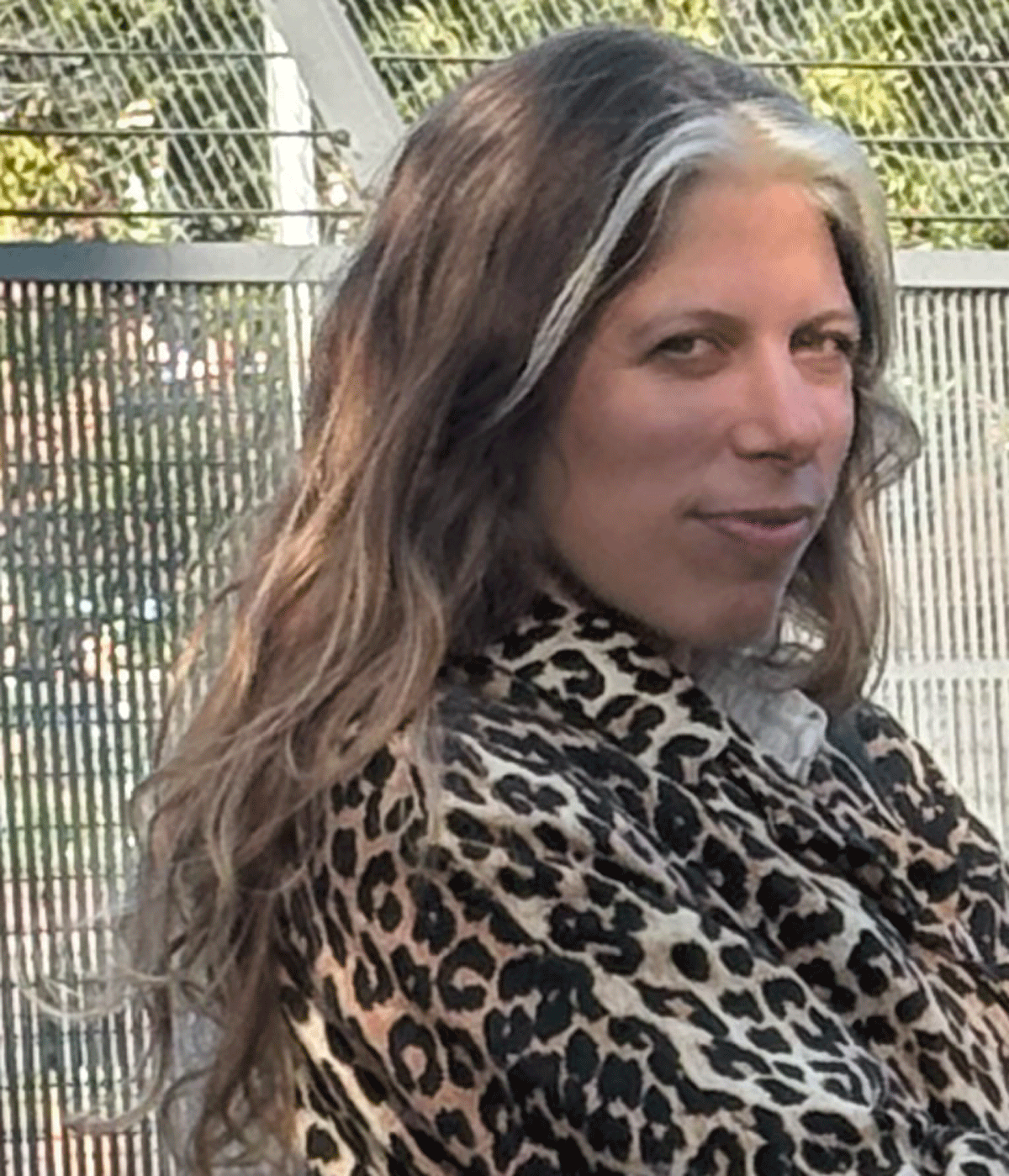

What does being a poet-in-residence involve? It is ‘a great opportunity to restore our sense of poetry as a profoundly social experience, instead of it being a strictly private, individual experience,’ says Patrick Rosal, recently announced as Guggenheim New York’s resident poet for 2026. ‘From griot to liturgical cantor to babaylan to Greek chorus, we have experienced poetry as live utterance across the entirety of human history and culture.’
New Jersey-based Rosal is well placed to consider the issue. A professor of English at Rutgers University–Camden, he has published several poetry collections to widespread acclaim, receiving awards, including the Lenore Marshall Poetry Prize, and fellowships, notably from the National Endowment for the Arts and the Fulbright Research Program.
Rosal is interested in the links between his words and the earth, intertwining reflections on human connection with an appreciation of the tangible. In his works, Rosal gives his ecological approach a sensory edge, a philosophy encapsulated in his residency here, titled The Water Listeners.
By thinking of poetry as both written and spoken in a ritual context we can invite people to experience a larger, culminating performance
Patrick Rosal
Rosal is inextricably drawn to water. ‘For decades now, I've been dreaming of water and storms, incredible cataclysms. In my dreams, I've stood before massive walls of water just as they're about to crash ashore. I've watched cities crumble into the banks of a river. I've seen the horizontal blur of a devastating typhoon outside a bedroom window. And in waking life, on our own street in Rahway, New Jersey, we get floods pretty quickly when big storms hit.’
Rosal is keen that expressing this sense of power extends beyond words, wanting also to involve visitors and encourage them to interact. As part of his residency, he has devised a five-question interview about water which people can ask each other, triggering conversations that become the foundations of poetry. ‘It's the opportunity for remembering, imagining, and listening, which is what poetry is, in the end,’ he adds. ‘And water is so embedded in our memory. Some of us have an ongoing conversation with water, not just as researchers or artists, but as cooks, janitors, clerics, nurses, as those who love to swim and those who are terrified of lakes. In the aggregate, we might listen to each other listening to the story and song of water, and maybe that makes a kind of literature. This Guggenheim residency lets me take some of these components and principles of language, attention, and ecology, and design some gatherings that invite the public to work with the elemental material of poetry.’
I want to think about the way language, story, and song circulate through time and space
Patrick Rosal
It is a project rooted in Rosal’s own experience. Growing up in New Jersey - where he has since returned to live - meant that museums in general felt distant and unapproachable. ‘Almost none of the people I grew up with think of the Guggenheim as a place to visit regularly,’ he says.
He is keen to change this perception, considering the architecture of the museum itself as a way of opening this dialogue. The museum’s fountain, from which the space opens up into a light-filled spiral, is a circulatory talking point from which to transform the museum with the sound of poetry. ‘With that in mind, I want to think about the way language, story, and song circulate through time and space, like water itself, a way for poetry - its images, ideas, language, and feeling - to flow and return the way rivers do. In sensory terms, poetry-as-sound has this spatial dimension. By thinking of poetry as both written and spoken in a ritual context we can invite people to experience and perhaps even craft artifacts that will be part of a larger, culminating performance around water that collaborates with the rotunda or other spaces in the museum architecture.’
Receive our daily digest of inspiration, escapism and design stories from around the world direct to your inbox.
The Guggenheim Poet-in-Residence programme, established in 2021, is made possible by the support of Van Cleef & Arpels
Hannah Silver is Head of Art & Culture at Wallpaper*. A writer, editor and author with over 20 years of experience in journalism, spanning national newspapers and independent magazines, she has overseen offbeat art trends and conducted in-depth profiles for print and digital, as well as writing and commissioning extensively across the worlds of culture and luxury since joining in 2019.