
Twelve minutes into Lift, an Irish-Catholic lady makes a startling confession in the elevator of Denning Point tower block. 'You asked me what was on my mind. Then I thought, nobody had asked me that before,' she says, an epiphany unfolding in the confines of a metallic booth, ascending towards the heavens.
It’s one of many sublime moments in the film, directed by Marc Isaacs and premiered in August 2001. Every day for two months, Isaacs squatted in the building’s lift with a handheld camera, inviting residents to share their innermost thoughts. The resulting vignettes were bolted together across 25 otherworldly minutes, revealing the heterogeneity of London’s high-rises. It was nominated for a BAFTA in 2001, screened across the world and became a cult classic on YouTube.
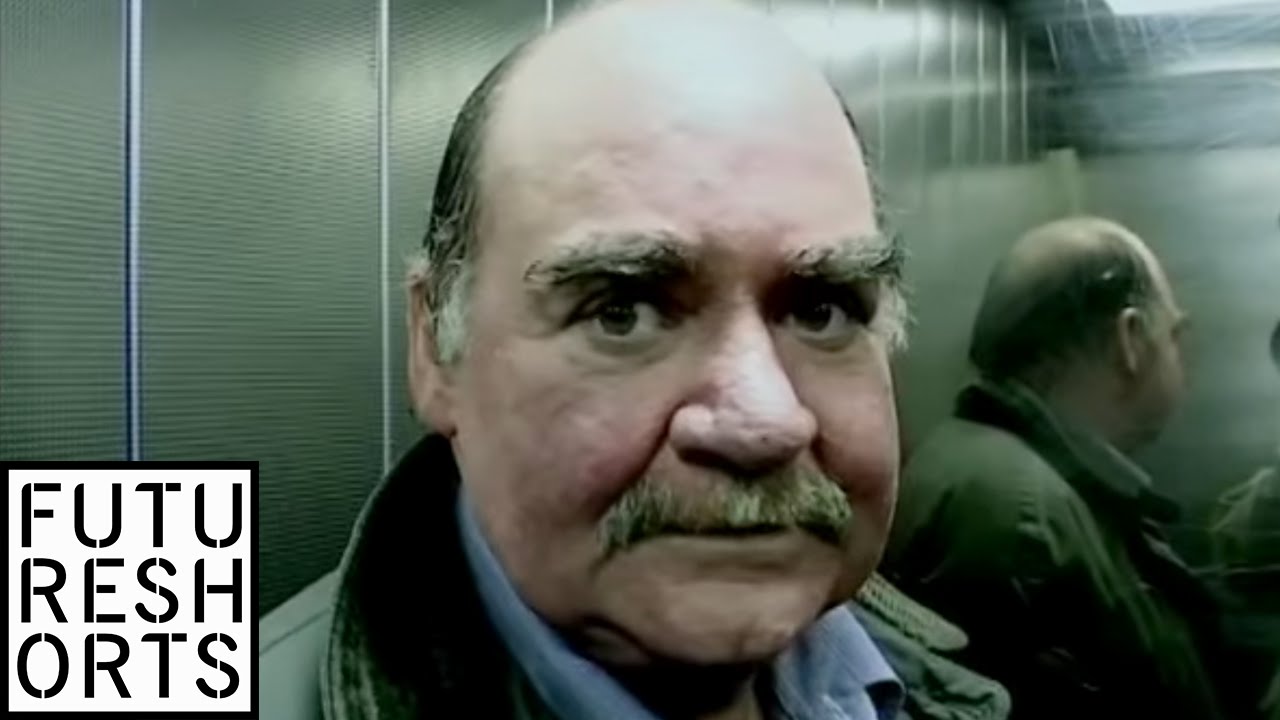
Now, 25 years on, drawing on recent Instagram interest, Isaacs has compiled 82 stills from the project for a limited run of 100 hand-numbered, signed books. The photographs are introduced with a three-column poem, written by Isaacs, that traverses three time periods: a contemporary part, which sees him observing Albanian-heritage immigrants from his local cafe; a middle part reimagining a dialogue from Lift; and a past part, comprising memories of Isaacs as an eleven-year-old working on a market stall outside the tower block, selling tea towels at four for a pound.
Isaacs, speaking over Zoom from his London studio, remembers Lift’s origin story. Back in February 2001, he had been all set to propose a film for Alt TV, a new experimental strand from Channel 4, about a mysterious fight club for London’s city boys. But the channel’s commissioners, at a meeting, revealed they were already working on the exact same idea.

Thinking on his feet, Isaacs remembered taking a tower block lift up and down every day while working as an assistant on Paweł Pawlikowski’s gritty drama Last Resort (2000). So came his literal elevator pitch: 'I said, I haven't really thought about it at all, but I'm quite interested in making a film in an elevator.' Later that night, at an awards party, he bumped into the commissioning editor in the toilets, who said it had got the green light (budgets were more forgiving, back then).
After enlisting researcher Andrew Hinton to knock on every flat and get a quick bio, Isaacs began to realise that the perfect 'microcosm of London' was hidden away in this Tower Hamlets high-rise. Spontaneity, at first, was key. 'The first two weeks were really exciting. It was really novel. The doors would open, somebody would get in, something would happen.' But Isaacs understood he would have to ask questions to get the main characters talking. It leads to enlightening, miniature conversations. When one gruff man, Peter, is asked what the best thing about his childhood was, his eyes twinkle up and he slurs: 'I’ve seen a golden eagle. It was a big, beautiful thing.' Another man reveals that he was sectioned for schizophrenia after his parents died in the space of a year, the highlight of his life winning a recorder competition in school.
Every night, Isaacs would transfer everything to VHS and watch back what he had been shooting. After a while, several key characters emerged, whom he would sometimes invite back into the lift to build a concrete narrative. If Lift has a protagonist, it’s Lily, an elderly Jewish lady who has lived in the block for 26 years. Positioned as the matriarch of the building, she shoos away tenants at will and leads a rising othering of new tenants. 'It was paradise. Now I've got “troubles” upstairs drilling and banging. Bad health to ‘em all,' she says. At one point, another woman shockingly quips: 'I don’t think we’ve got 20 Jewish people anymore. I was counting the white people when I couldn't sleep last night.'

For Isaacs, who is of Jewish heritage, filming Lift revealed a nuanced form of xenophobia. 'The old Jews would have felt like their world is changing because of the Bangladeshis. Then subsequently, the Bangladeshis would reach to migrant workers from Ireland or Eastern Europeans [...] there were layers to people’s prejudices.' On one occasion, Isaacs himself is even seen as an impostor, perversely framed as a voyeuristic claustrophile. 'What motivates you to want to stand in lifts for 10 hours a day. Is it the confined space you like?'
These stark, often self-sabotaging comments reframe the lift as a confessional space. Lifts are everyday contraptions that get you G to 1 and beyond, but they are also a portal to another world, with a strange limbo between. 'You’re in a completely nowhere space. You’re not in the flat or on the street. You’re suspended in time for 20 seconds. It gave the film a rhythm.' At times, the lift’s mechanical entrails are revealed, breaking this effect like an illusionist exposing their magic boxes.
But it’s the people, rather than the space, that make Lift so special. There’s a surreal romance; one South Asian heritage man, speaking in broken English, continually offers Isaacs food, ending with him teaching Isaacs how to chew betel. There’s optimism; one archetypal New Labour bachelor, who has a sauna and jacuzzi in his flat, shares a carefree attitude. 'I quit my job yesterday,' he says, grinning, returning to talk about Brick Lane curries, his aftershave and going on the pull. But there’s also despair; one man, swaying with a can of super strength lager, can’t bear to show his face to the camera.

At one point, a fly is seen creeping across the wall of the lift. One critic thought it was an ingenious piece of commentary on this point-and-shoot, 'fly-on-the-wall' filmmaking. In reality, they were enlisted as B-roll fodder. 'I wasn't even thinking about that [metaphor]. I bought them in a pet shop in Leytonstone for like 50p for two,' he says, laughing.
Ultimately, like the lift as an object, the film captures a fleeting moment in time, caught between two milleniums. It’s epitomised by one interaction between a man, who owns a local independent coffee shop opposite Starbucks, and a female resident, speaking about the new American franchise’s plans to open 200 more branches in the UK. 'Hopefully they're going to close very soon,' he says, satisfied by the £39 net profit he’s made today. 'Starbucks won't be able to manage against Mr. Coffee,' she says, entirely sincerely. The dramatic irony is piercing.
But Lift’s spirit persists via the medium of YouTube. One woman recently wrote to Isaacs after seeing Lift on the video sharing platform; she had remembered him filming her when she was a little girl. Another has kept in contact with Isaacs and ended up playing a bailiff character in one of his later movies. Isaacs’ latest film, Synthetic Sincerity, set to be premiered at Sheffield Doc Fest in June, imagines him making a deal with an AI research project to use his film’s characters as training data: several Lift characters feature.

Most strikingly, Lift feels strangely zeitgeisty due to its off-the-cuff interviews: it predates and, perhaps, predicts the onslaught of lukewarm TikTok takes, violent vox-pops and Ray-Ban Meta secret filming. Lift now would, perhaps, be called Elevator Takes (there is, consequently, a social media DJ series called Elevator Music.) But Isaacs feels it would be impossible to make a 2026 take on Lift that he would be happy with.
The candour that once met the camera has been replaced by a shared manufactured persona, spoken into a tiny mic. 'They all say the same thing. I need to have healthy eating habits or use the right kind of moisturizer or I learnt to be myself. They talk this Instagram language.' In this sense, the realness that grounds the entire premise of Lift has been lost. 'People were much less bothered about what they were doing. Now, everyone is mediating themselves,' Isaacs says. 'And, with what's happened to the image, you don't even need a camera anymore.'
Pre-orders for 'Lift' are open now