Two tapestries designed by William Kentridge open one of the early galleries at Palazzo Mora, woven by the Johannesburg-based Stephens Tapestry Studio in hand-spun, hand-dyed mohair in centuries old tradition. They form part of the Porter Series of tapestries that Kentridge has made in collaboration with the studio and respond to the theme of migration and ‘portage’ – or to bear one’s cargo between seas and rivers. We see silhouettes and figures heavy with artefacts, crossing continents, as depicted by maps from nineteenth-century atlases. The images are restless, in motion, forever migrating.
They set the tone for the eighth edition of Personal Structures. The exhibition, organised biennially by the European Cultural Centre Italy, which runs alongside but independent of the Venice Biennale, and has taken ‘Confluences’ as its theme.
A few canals from the Arsenale and Giardini, where national pavilions arrive heavy with the politics of the moment, the Marinaressa Gardens, and palazzos Mora and Bembo offer something quieter. Personal Structures has, since its founding in 2002 by the artist René Rietmeyer, sought to be an open platform for established, mid-career and emerging artists, and it allows each curatorial circle to set its own pitch. This year sees more than 150 artists from over 30 countries gathered across the three venues.

The Palestine Museum in the Mora Palazzo
‘With Confluences, different languages and perspectives come together, not to become the same, but rather to create something new,’ says Sara Danieli, who heads art at ECC Italy. The metaphor sits well in a city built on water, where for centuries east and west arrived in the same harbour and made something out of the encounter.
And it is this theme of movement and migration, of belonging or indeed not – be it physically or otherwise – that naturally dominates much of the exhibitions here. We see this at the entrance to Palazzo Mora, where the artist J. Oscar Molina’s ‘Cartographies of the Displaced’ lines the courtyard representing the El Salvador pavilion for the first time at the Biennale. Curated by Alejandra Cabezas, the sculptures look up uneasy to the sky and read as a meditation on exile, and the struggle to ever truly belong to a place or a time.
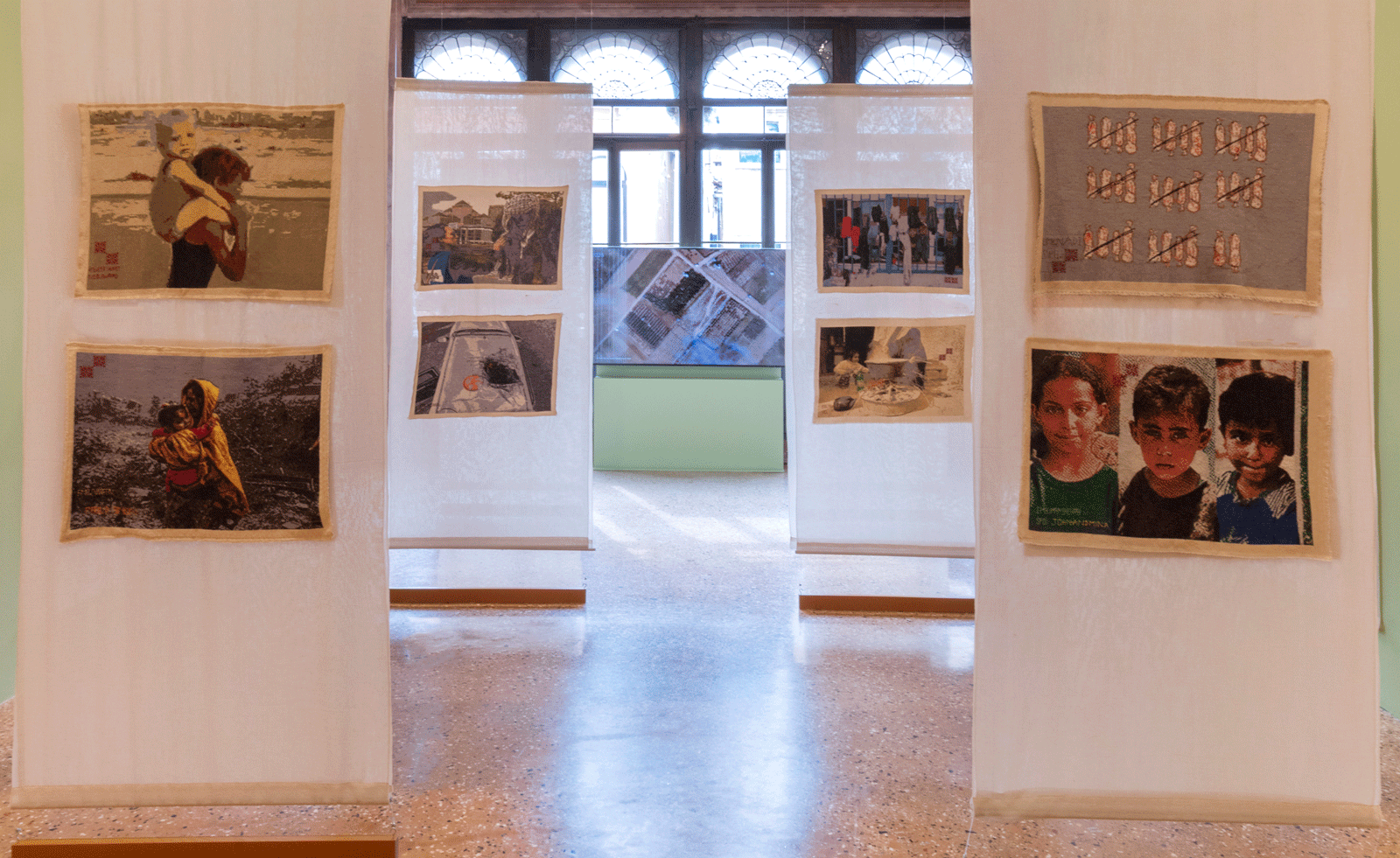
Upstairs Mora gives shelter to the Palestine Museum US, with a moving display of embroidered panels depicting images of the recent war. Organised by the museum director Faisal Saleh and forming part of the larger ‘Palestine History Tapestry’ project, the series sees work by sixty women in refugee camps across Lebanon and the West Bank who were commissioned to translate a series of photographs using the traditional embroidery technique, tatreez. Each piece is eighty centimetres by fifty and contains fifty-five thousand stitches. The panels hover between image and texture, and the labour held in each stitch slows the eye in a way photographs rarely do.

The El Salvador Pavillion
The mood lifts at Palazzo Bembo, where the top floor of this charming and peculiar building, with views over the Rialto Bridge and the Grand Canal, has been taken over by the Japanese curatorial platform B-OWND. ‘Relational Logic – Beyond Dualism, a World Reconnected’ invites the viewer to look at art beyond grids and boundaries, through the Japanese concept of ‘en’, the word for the connections that bind people, places and moments. Behind it sits the Buddhist idea of ‘ku’, or emptiness, which holds that all things are interdependent and arise temporarily through their relationships with others and the environment. There is an animist sensibility threaded through the rooms as well, one that recognises spirit in all things and sees humans and nature as part of a single, inseparable whole.
The exhibition unfolds from space to space, where seven artists work across art, craft and manga, and a separate room is given over to public tea ceremonies and meditation. The tea utensils on view, the flower vases and bowls, are tools for daily use, and have been objects of devotion for Japanese collectors for five or six hundred years. Ken Ishigami, the curator, quotes Sen no Rikyū, the sixteenth-century master regarded as the father of the Japanese tea ceremony: “The most beautiful thing in imperfection is perfection.”
At the centre of one room is ‘The Way of Interbeing’, a delicate, immersive site-specific bamboo installation by Tanabe Chikuunsai IV, the fourth-generation Osaka bamboo artist whose family has practised the craft for more than a century. Some four thousand strands of recycled tiger bamboo are woven together and held in place by tension alone. It reads like a single architectural gesture, past and future and west and east braided into one space. A final room, a collaboration with Shueisha Manga-Art Heritage, brings lithographs and lenticular prints from Hirohiko Araki’s ‘JoJo's Bizarre Adventure’, the fifth part of which is set across Italy and passes through Venice.

The Palestine museum
João Gilberto’s ‘É Luxo Só’, arranged by Stan Getz, floats through the gallery of the Brazilian photographer Sandra Cattaneo Adorno, a previous ECC Award winner who returns with ‘Fragments of Light’. Thirteen silver-inked monochromes hang against vermillion walls, and a central photomosaic of the Santa Monica pier reassembles itself as we move around it. The works tilt towards the light streaming through the vast palazzo windows, like sunflowers opening to the sun, says the artist.
Elsewhere in Palazzo Bembo, another Special Project, ‘Unison’, brings together work by the Vienna-based artist Rita Sabo. Curated by Dr Tayfun Belgin, the installation weaves fifteen cultures into a single polyphonic field, layered as painting, sculpture, scent and sound, so the visitor moves through the rooms by all the senses at once. Sabo’s abstract forms delve into the subconscious; her practice fuses traditions and religions and symbol-systems, setting up a vibrating field of marks that resists linear timelines, fixed narratives and singular cultural attributions. Her richly textured work pushes past the linear and the obvious, for something altogether more subtle and hidden.
More sits across the three venues than a single visit can hold, and it is tempting, in an exhibition of this scale, to seek a single argument. Personal Structures actively resists the impulse, and that is its strength.
I’m reminded of something William Kentridge said last year at the Yorkshire Sculpture Park, when asked whether he had any hope in a world that for many of us feels increasingly dark and difficult to digest. ‘I have both hope and pessimism, both running together. I think to have only one or the other is to blind yourself to part of the world, and say everything can only be a disaster. It blinds you to many things that are happening. And to say everything’s for the best blinds you to disasters that are very, very present.’ It is the holding of both that makes his work resonate so widely, and the same holding makes ‘Confluences’ feel coherent.
‘Personal Structures – Confluences’ is on view at Palazzo Bembo, Palazzo Mora and the Marinaressa Gardens, Venice, until 22 November 2026. Admission is free.