
The work of Lutz Bacher isn’t interested in creating clarity. Although the artist’s decades-long practice used found images, and figures in American history who were both iconic and infamous, it seems that she was never interested in making these people – or the spaces in culture and a national psyche that they might occupy – transparent or easy to understand. Bacher herself worked under a pseudonym, and her likeness appears only once in the career-spanning retrospective ‘Burning the Days’ at Wiels in Brussels – in a photo series that seems to wink and satirise the image of the artist in a studio.
'It’s important to state that we didn’t want to solve who Lutz Bacher was,' the curator Helena Kritis reveals, wanting instead to focus on the idea of instability. The identity and role of the artist is inherently unstable in Bacher’s practice; from her relative invisibility across decades of the work, to the way that the idea of a sense of self can become malleable in the face of this art, and its deliberate overabundance of images.
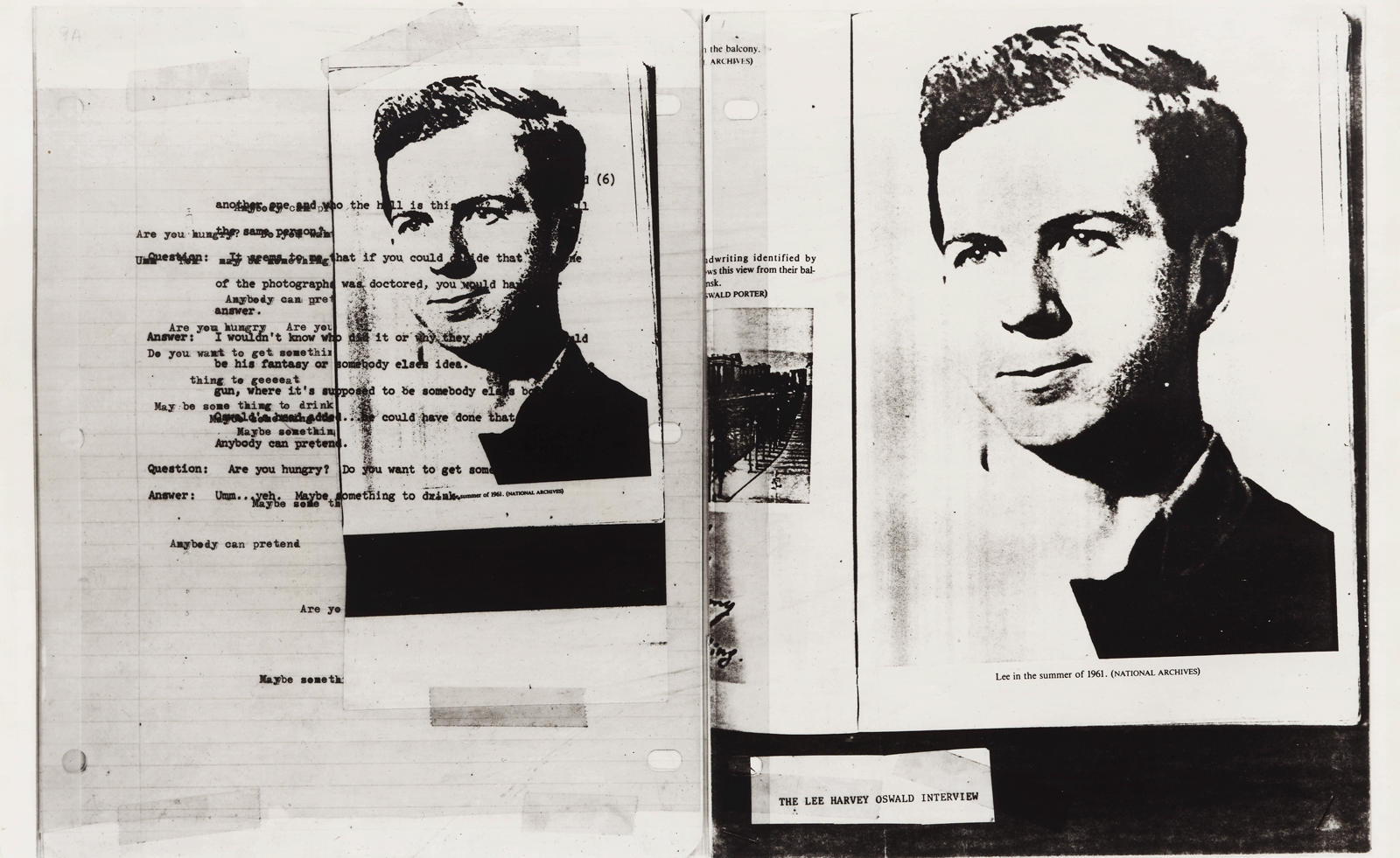
Lutz Bacher, The Lee Harvey Oswald Interview, 1976-78
‘Burning the Days’ opens with a piece that thrives in this unstable place. The Lee Harvey Oswald Interview (1976-78) is presented, on the surface, as an interview with the assassin who shot JFK. But in reality, this is a performance; Bacher herself takes on the role of both interviewer and subject, assassin and archivist. Bacher’s art comes to life in these uncertain spaces in between, where a viewer is forced into a double-take looking at the work. In one of the fragments of text that make up the ‘interview’ (collaged on top of images of Oswald himself, manipulated and distorted by the artist), Bacher-as-Oswald says: 'It should be that more pictures should tell you more, but what happens is that they tell you less and less.'
By drawing on the endless stream of images that make up the language of pop culture – Bacher’s work involves everything from Troll dolls and archival images of celebrities, to toy tanks and cardboard cut-outs of Elvis Presley – she is constantly asking about not just the role that these objects play, but how a viewer might interpret them. For Kritis, Bacher’s work 'refused [the] notion of a clean distinction' between critiquing the imagery and institutions of American culture, and being complicit in the way they can be deployed.
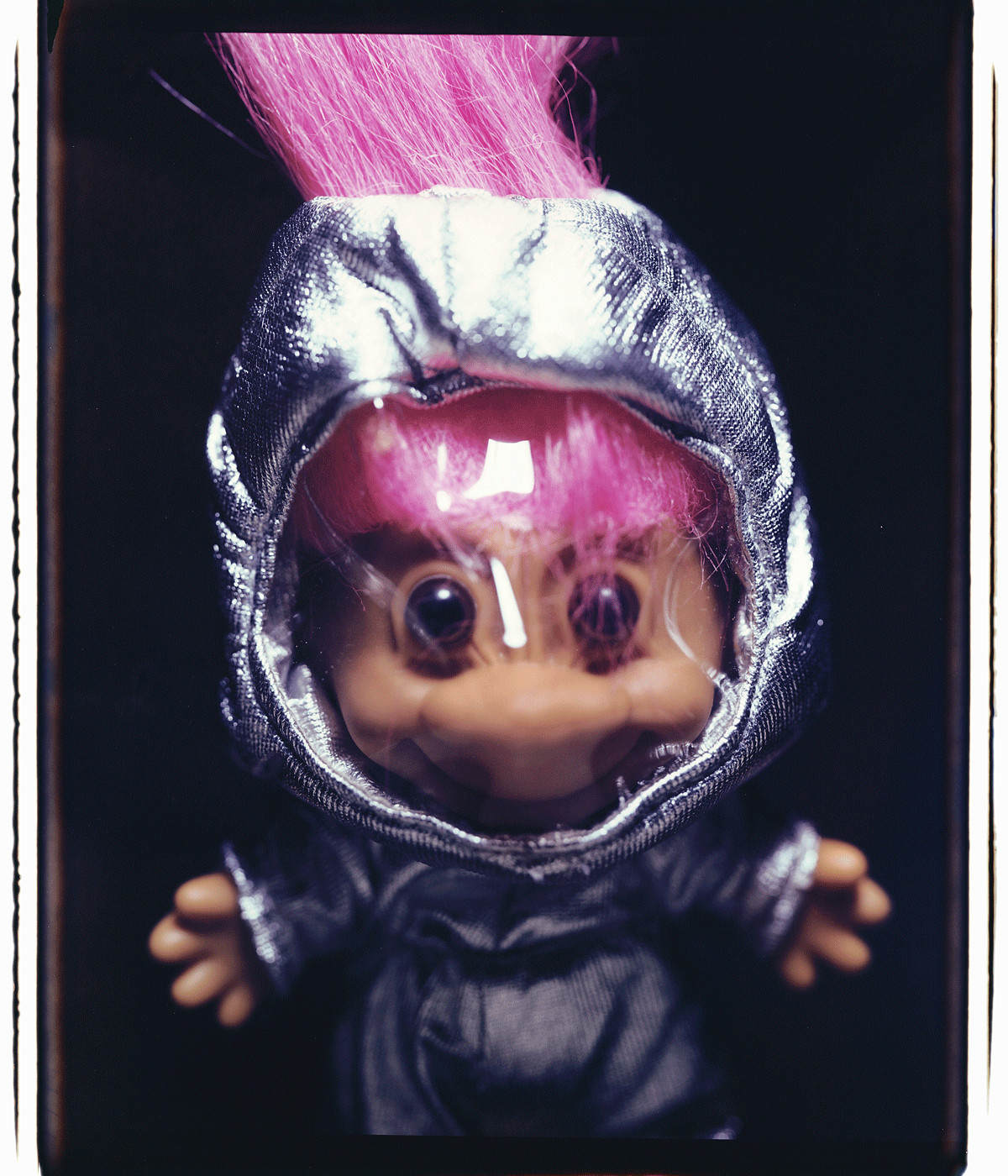
Lutz Bacher, The Little People (Cosmonaut)
As Kritis puts it: 'She allowed the images to be seductive and visible, but then she also distorted them and exposed how they produced desire, paranoia, conspiracy or myth.' Nowhere is this clearer than in the pairing of two pieces of Bacher’s work on the exhibition’s second floor – what Kritis calls ‘constellations’ – one of which is the wire skeleton of a buffalo, synthetic flesh hanging off of it, materiality of its construction exposed.
On the wall next to it is Men at War (1975), a series of images of American soldiers relaxing on a beach. Read from left to right, Bacher’s treatment of the images – zoomed and cropped, creating a very specific, narrow field of vision – moves further out until it reveals a soldier with a swastika tattooed across his chest. These moments of shock and uncertainty, as if one had been jolted out of reverie, occur throughout the exhibition, in ways that ask questions around complicity and the insidious nature of engaging with culture, and the politics surrounding it, too passively.
There are times where this is done for sly, comic effect; a riff on the pin-ups illustrated by Antonio Vargas for Esquire and Playboy, which Bacher presents alongside knowing, political aphorisms and jokes in cursive text; Playboys (Inflation) from 1993 reads 'of course, there are certain kinds of inflation that I don’t mind at all'. Kritis admits that viewing these images might make someone a little 'uncomfortable', now, still stressing the idea that what Bacher did with the series was take 'this intimate image and make it public; [she] showed the blatant sexism, and made us complicit in watching it together'.

Lutz Bacher, Jackie & Me, 1989
While ‘Burning the Days’ isn’t a chronological retrospective of Bacher’s life and work, it does seem to have an arc that ties it all together. Ascending each of the three floors (and roof terrace) at Wiels where the exhibition is on show, a movement away from the embodied and visual world of mass culture turns into something more abstract and spiritual. One of the final works on the exhibition’s second floor is The Road (2007), a series of 13 images that follow the curve of a road, stopping before the corner is turned.
There’s a movement away from the id, the traceable understanding of culture and its imprints (one striking moment, that illustrates how Bacher’s work interacts with the specificity of where it is exhibited is a toy tank on the wall, tread marks behind it, discolouring the white museum surface), and towards unanswerable question of exactly what it is that lies just out of our reach. On the third floor of the space, the installation Black Beauty (2012-13) – a surface of black silica made to approximate the surface of the moon, with footprints traceable through the room – is paired with Blue Moon (1996), a multi-channel video of the moon, solitary in the sky, and the voices of Bacher and her husband, the astrophysicist Donald C Backer, heard slightly muffled, as if coming from another room.
Bacher’s work, no matter what form it takes, is always fascinated by the power in discovered, repurposed, discarded material. And yet, this seems to fall away at the exhibition’s end, leaving behind a married couple, a far-off celestial object, and the ability to trace the footsteps that led us here.
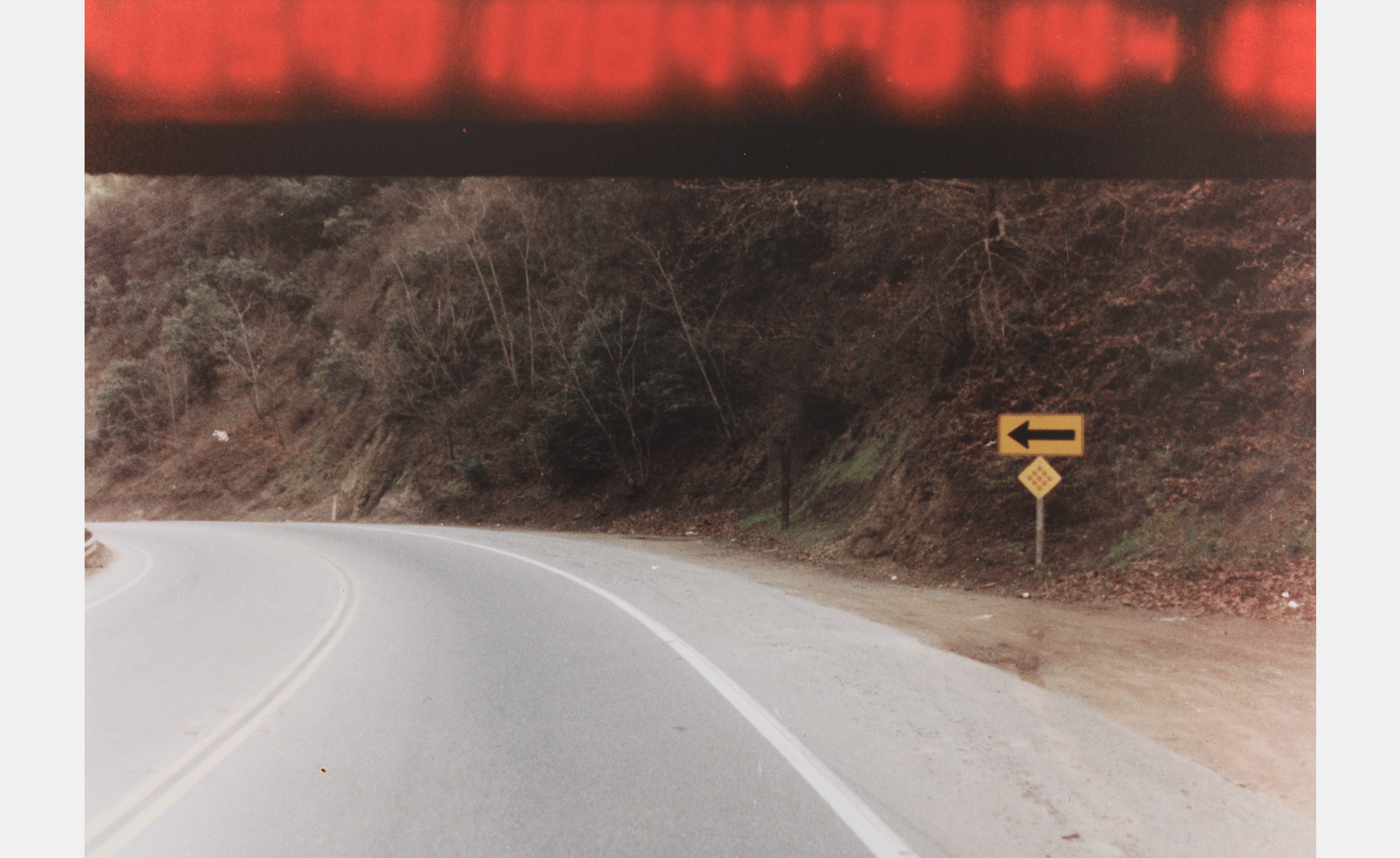
Lutz Bacher, The Road
Kritis pushes up against the artistic tradition that Bacher is most often seen as being a part of: the readymade, found objects repurposed for a new context. Chess (2012), features a replication of one of Marcel Duchamp’s most famous readymade images: a tricycle, turned upside down. Bacher places this between giant chess pieces, and a cardboard cutout of Elvis, as a looping, distorted version of one of his songs plays in the background.
Kritis instead argues for Bacher’s practice as one 'attracted to things carrying a past already charged with social and emotional traces'. ‘Burning the Days’ approaches this in a way that seems like a mirror of the artist’s own approach to making work: by eschewing linearity and easy answers, and instead making tense, sometimes unsettling connections that flicker with the possibility of a new world.
‘Burning The Days’, developed in collaboration with Astrup Fearnley Museet, is on until 9 August at wiels.org

Lutz Bacher, Bingo (or the year I was born), 2008