Each mundane object tells a story at Pace’s tribute to the everyday
In a group exhibition, ‘Monument to the Unimportant’, artists give the seemingly insignificant – from discarded clothes to weeds in cracks – a longer look

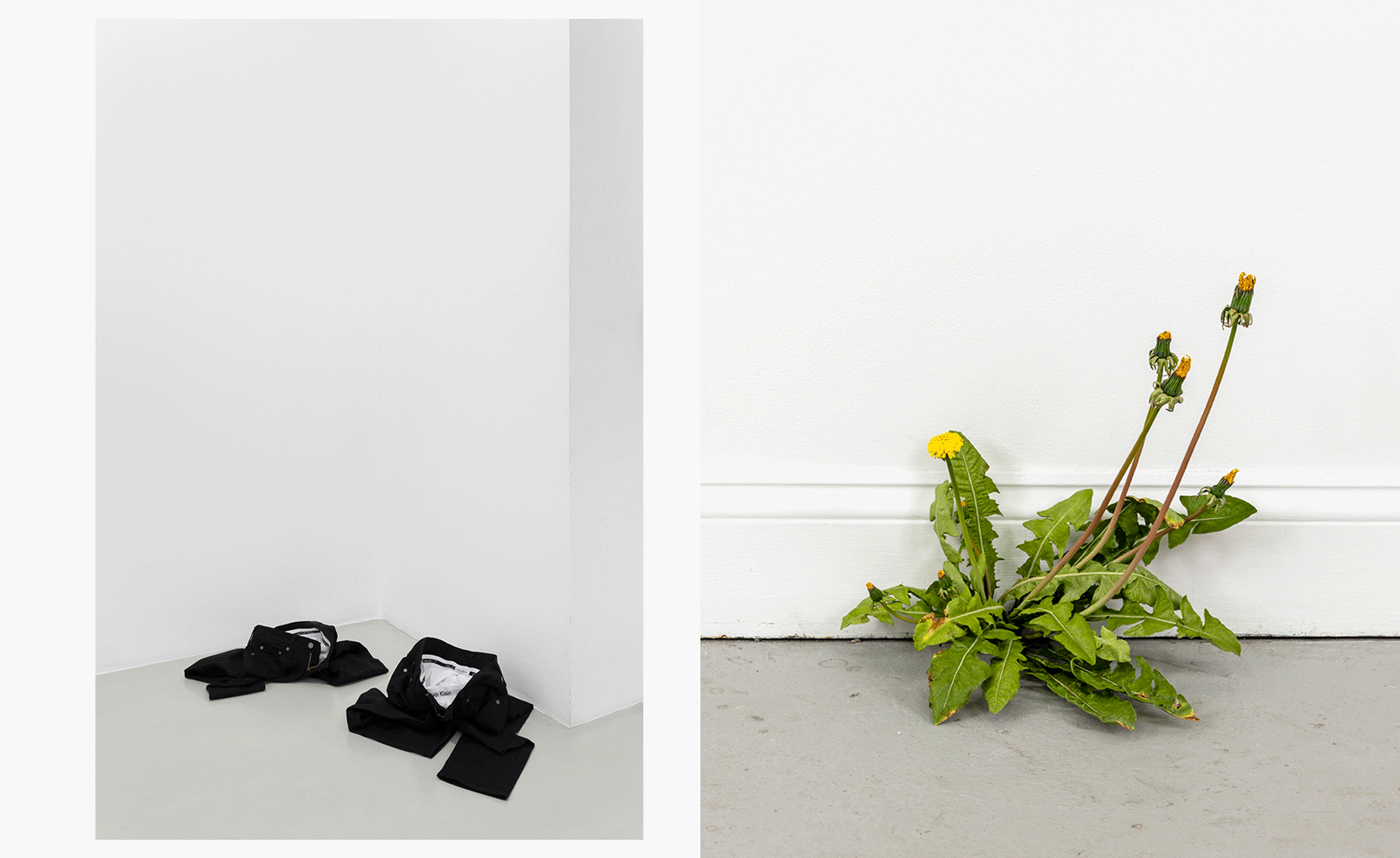
The objects and things that fill our daily lives are often ones we only notice if they stop working, or if they inconvenience us in some way. The cakes that haven’t risen, the cables that don’t connect or the weeds growing through the crack in the path – all will receive our full attention only when they become a nuisance.
But currently at Pace, London, these items and more are celebrated as things of beauty in their own right, with the group exhibition ‘Monument to the Unimportant’ spotlighting the joy in mundanity. Artists including Henni Alftan, Genesis Belanger, Elmgreen & Dragset, Urs Fischer, Sylvie Fleury, David Hockney and Rachel Whiteread recontextualise the quotidian to create something wholly new.

Genesis Belanger, Do Not Disturb, 2025

B Wurtz, Untitled (Steamer), 1987
‘Artists return to everyday objects because they’re universal and endlessly revealing,’ says Karine Haimo, senior vice president at Pace. ‘The things we barely notice, such as food, furniture, domestic tools, quietly shape our lives. When artists alter scale, material, or context, the familiar becomes strange again, and we’re prompted to look with fresh attention. The works in “Monument to the Unimportant” show how powerful that shift can be. A cake, a pretzel, or a hot-water bottle might seem trivial, but in an artist’s hands they become ways to talk about culture, the body, memory, and the rhythms of daily life. The mundane offers a shared language.’
Looking at these items, left without anyone to operate them, bereft and useless, seems faintly ridiculous, ultimately emphasising our own vulnerability. In Genesis Belanger’s sculptures, the human’s presence is implied so deeply we feel like they must have just rushed away, leaving the phone dangling off its hook behind them. ‘Each object has the ability to tell a story about a person, culture and society,’ says Belanger. ‘It’s not so much that the context changes the meaning of an object, as it provides the space for the meaning to be revealed. A hot water bottle in your medicine cabinet may be invisible, but in a gallery it reveals its allegorical potential.’

Wayne Thiebaud, Little Deli, 2001

Claes Oldenburg, Ice Cream Sundae on Tray, 1962
It is a narrative made even more literal by Elmgreen & Dragset. In Powerless Structures, Calvin Klein underwear and black Levi’s are strewn on the floor, kicked off by their invisible wearer. ‘In our daily lives, we surround ourselves with myriad mundane objects, be they in our homes or within the public sphere, that we tend to overlook or take for granted without any further reflections upon what they actually represent,’ the duo say. ‘In order to break through the conventional readings of such ordinary items, you have to look at them from a new perspective, so that both the desires and the control mechanisms embedded in their designs can be revealed once again.’
Taken as a whole, the exhibition is unsettling, rooted in the uncanny and hard to place. ‘Many pieces seem immediately recognisable, but they reveal something new the longer you look,’ adds Haimo. ‘An ironing board reflected in chrome or a pair of intertwined urinals shifts from literal object to something more open and poetic. I hope people leave the exhibition with a heightened awareness of the things around them. The “unimportant” is never actually unimportant; it’s where our habits, histories, and emotions live. If visitors start noticing the everyday with more curiosity, that’s the real impact of the show.’
‘Monument to the Unimportant’ at Pace, London until 14 February 2026, pacegallery.com