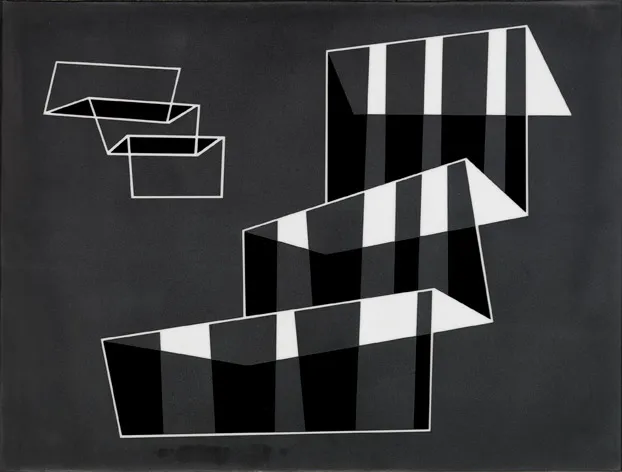
A Josef Albers exhibition in black and white sounds like a conceptual gag. Albers, after all, is the colour man. His book Interaction of Color even has its own iPad app. A lot of what we understand about colour we understand because Albers made us understand. But, as Albers understood, you can't understand colour if you don't understand black and white.
'Joseph Albers: Black and White' at the London's Waddington Custot Galleries, produced in association with the Josef and Anni Albers Foundation, brings together 50 works to explore Albers' adventures in monochrome. The exhibition covers paintings, works on paper, glassworks, photographs and engravings on vinylite, including a set of six Treble Clef gouaches from the 1930s as well as six Graphic Tectonic drawings from the 1940s and Structural Constellations from the 1950s that make clear that Albers was as much a master of line as colour.
It also includes Blick Aus Meinem Fenster Stadtlohn, his oldest extant drawing from 1911; Steps, a glass construction from his time at the Bauhaus; a number of photo collages and photographs taken during the Josef and Anni's numerous trips to Mexico; and eight monochrome versions of his Homage to the Square paintings. It's all there, as they say, in black and white.

'Structural Constellation', c. 1950

Study for 'Graphic Tectonic', c. 1941-42

Pyramid of the Magician, Uxmal, Mexico, 1952

Tenayuca, Mexico, 1937

'Homage to the Square', 1962

Colour study for 'Homage to the Square', c. 1950
ADDRESS
Waddington Custot
11 Cork Street
London