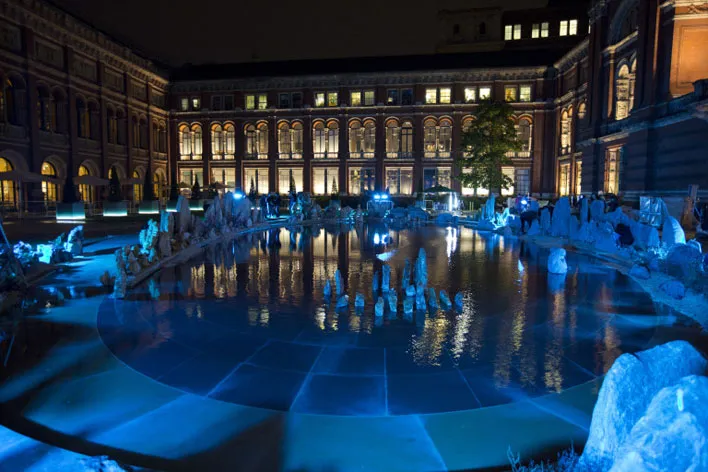
'Travelling to the Wonderland', a new installation at the V&A's John Madejski Garden by artist Xu Bing, conjures the ancient Chinese story 'The Peach Blossom Spring', in which a man finds an idyllic village, cut off from the rest of the world
What westerners, of a particular age anyway, call Shangri-La - an inaccessible (and perhaps not really there) mountain paradise where life is slow and sweet - is also what Tibetan Buddhists call Shambhala and many Chinese call The Land of the Peach Blossoms. It is an ideal often conjured up during times of imminent threat. And the Chinese artist Xu Bing has conjured it up again in a new installation, Travelling to Wonderland, at the V&A's John Madejski garden.
Xu Bing has carted slices of nine different rocks from five different places in China and arranged them here to create a magical miniature mountainscape, dotted here and there with tiny ceramic houses, and surrounding the garden's water feature that becomes a huge, and at some times of the day, mist-shrouded lake. As Bing says, he has played with scale here in a disarming way and the installation is somewhere between rockery and monumental land art, a genuine landscape but far more mysterious than any model village you have seen.
It is at once an arcadia, a warning about the dysfunctional relationship between man and nature and a direct response to the V&A's blockbuster survey of Chinese art, Masterpieces of Chinese Painting 700 - 1900. The two have to be viewed together.
The Masterpieces exhibition boasts a remarkable series of landscape paintings, some on enormous scrolls. As the exhibition's accompanying text advises, these paintings are not of real places but imagined places and the mountains roll up the picture in rhythmic undulations and blend into the clouds. There are pictures of a working cosmic order.
Xu Bing explains that each of the different rocks used in Travelling to the Wonderland represents a different style in Chinese landscape art and suggests that his piece is a '2.5' dimensional take on that tradition. The art on those giant scrolls was not meant to be taken in at once but 'scrolled' through, journeyed through, taken in section by section, each one revealing new landscapes. As Bing says, it is a surprisingly modern, filmic effect and something he aims for here.
As we talk, Xu Bing inspects the installation and says that there are still details to attend to, houses to be straightened. Some of them will have lights and LCD screens, suggesting that this is not some pre-Lapsarian fantasy, that utopias need cable, or perhaps that this mountain hideaway is not hidden far away enough.

Xu Bing carted slices of nine different rocks from five different places in China and arranged them here to create a magical miniature mountainscape, drawing elements from Chinese landscape scrolls

Tiny ceramic houses sit atop rocks, surrounded by a misty lake
Hear the tale behind the artwork from Xu Bing, pictured with components of the installation in his Beijing studio

A corner of tranquility in Xu Bing's installation, where every detail is considered
Watch the installation being assembled inside the John Madejski Garden

'I think today's people really wish to find a natural, quiet, egalitarian and harmonius place to live', says the artist

At night, Travelling to the Wonderland is lit by blue light and fog rolls across the scene. It stands in stark contrast to the Victorian façade of the V&A

Bing's work is a direct response to the V&A's Masterpieces of Chinese Painting 700 - 1900 exhibition, which boasts a remarkable series of landscape paintings, some on enormous scrolls

Courtesy The Nelson-Atkins Museum of Art, Kansas City
An excerpt from an album of landscapes by Gong Xian, 1671.

Courtesy The Nelson-Atkins Museum of Art, Kansas City
A mountainous landscape by Gong Xian, 1671.

Courtesy The Nelson-Atkins Museum of Art, Kansas City
A speckled landscape from an album by Gong Xian, 1671.

Courtesy The Nelson-Atkins Museum of Art, Kansas City
A small house sits in the foreground of this landscape by Gong Xian, 1671.

Courtesy The Nelson-Atkins Museum of Art, Kansas City
Another landscape by Gong Xian, 1671.

Courtesy Osaka City Museum of Fine Arts
'Farewell to Hao Xuanming', by Hu Shunchen,

Coutresy The Metropolitan Museum of Art, New York
'Cloudy Mountains', by Mi Youren, circa 1140.

Courtesy Liaoning Provincial Museum
'Prosperous Sozhou', by Xu Yang, 1759.

Courtesy Museum of Fine Arts, Boston
'Temple Among Snowy Hills', early 13th century.

Courtesy Museum of FIne Arts Boston
'Bare Willows and Distant Mountains', by Ma Yuan, late 12th century.

Courtesy The Nelson-Atkins Museum of Art, Kansas City
A scenic landscape by Gong Xian, 1671.

Courtesy The Nelson-Atkins Museum of Art, Kansas City
'Saying Farewell at Xunyang', by Qiu Ying, circa first half of 16th century.
ADDRESS
The V&A
Cromwell Road
London SW7 2RL