
The smart home remains better in theory rather than practice. If you’re happy wrestling with apps and devices and delighted to dig into the dark arts of APIs and Arduino kits, then the smart home is a veritable playground, where you can oversee devices wrestling digitally to your heart’s content.

The Doma door recognises you and opens automatically
Truly accurate data is hard to come by, but one survey by the American Journal of Consumer Affairs reckoned that on average, a typical US household had around 21 connected devices in no less than 13 device categories. By 2025, the JCA reckoned that over 57% of American homes would have at least one smart home device.
However, most of us don’t have the inclination, or time, to adjudicate the constant data wrangling required. And if you’re on the fence, recent high-profile hacks and data breaches are hardly great ads for even more connectivity.

Recognition is via an onboard facial scanner
Doma is a new San Francisco start-up that wants to do the smart home differently. So differently, in fact, that they’re dubbing it the ‘intelligent home’ instead. The new company was set up by industrial designer Yves Béhar and entrepreneur Jason Johnson, who previously collaborated on the smart lock startup August Home. August was formed in the white heat of the first age of the ‘internet of things’, and although the company still exists under new ownership, both Johnson and Béhar felt there was another path.

The door can also be set up to be accessed via a keycode or a QR code
‘We didn’t feel the really ‘smart home’ happened,’ says Johnson. Hence the creation of Doma and the emphasis on the intelligent home, a place where Silicon Valley’s dreams of technology integrated with life takes on a more discrete and helpful character. Doma’s key pillars are health, wellness and safety. It’s the latter that is the focus on the company’s first two products, Doma Intelligent Doors and Doma Intelligent Windows.

The opening mechanism is concealed within the frame
Unlike August, which sells door hardware, Doma is baked into doors and windows at source, compatible with several leading American suppliers at launch with more to follow. The reason for this integration is twofold; the system goes above and beyond what August offers, with motorised opening and closing, along with integrated camera and security features.

The system doesn't require specialist door frames
Doma is agnostic about style, with a simple flat rectangular control panel on the inside and a round screen on the exterior. The latter integrates both a regular camera and a facial recognition scanner. ‘We’re bringing a layer of intelligence to the whole industry,’ says Béhar, ‘from the outset we designed the product to become the intelligence layer for the home.’

The Doma system can be integrated into a huge number of different door types and materials
In a nutshell, Doma’s system grants access to those it recognises, with no less than six different means of authenticating the right person. It’ll then unlock and start to open as you approach, closing and locking behind you. On the inside, the control panel sits flush with the door and integrates with any existing alarm system or the Doma app. When it’s off, you’re none the wiser – it just looks like a mirrored panel on the door.

A detail of the Doma control panel with its peephole view
Doma’s claim to enhancing life through intelligences comes from this combination of clean, unfussy design and a straightforward, near-silent mechanism. Who wouldn’t want such a simple system, with the convenience and security benefits it brings? Add to this the clever integration of the door cam, which shows up on the control panel as a live video peephole that can be expanded with a simple touch.

Doma intelligent door system
That’s not all. The control panel also has indicators for air quality, pollution levels and weather data. This becomes even more interesting when paired with the Doma windows, which feature the same WelcomeDrive motorised technology and can be set to open and close to maintain preset temperature or air quality levels. Both systems fit into specially routed pockets within the doors – hence their wide compatibility – and are hard-wired to avoid the need for batteries.
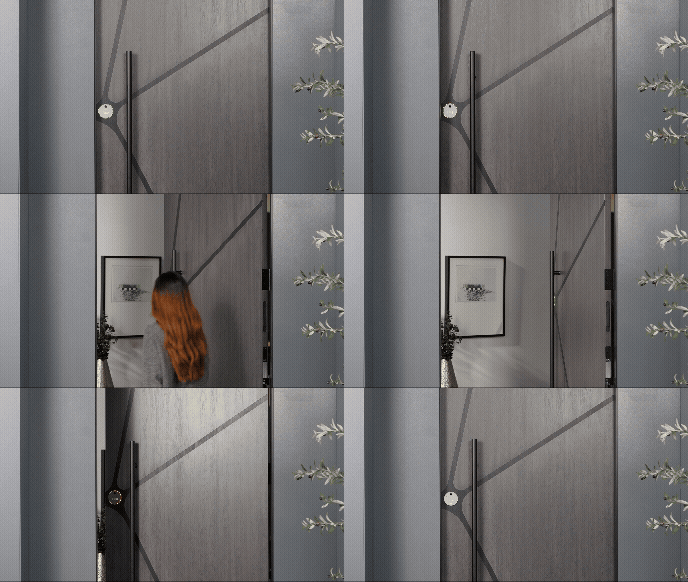
Doma door system in action
While other smart lock systems can lock and unlock doors, only Doma can actually close and lock up a house – or let in a friend or trusted tradesperson. Again, it’s about intelligence and user experience, not just a collection of products, each with a single purpose.
‘There’s a lot of innovation in this industry in terms of experience,’ says Béhar, ‘Doma can be the experience layer for the industry.’ With other ideas in the works, has Doma finally found a way to make home automation truly intelligent?

Welcome home. The Doma front door