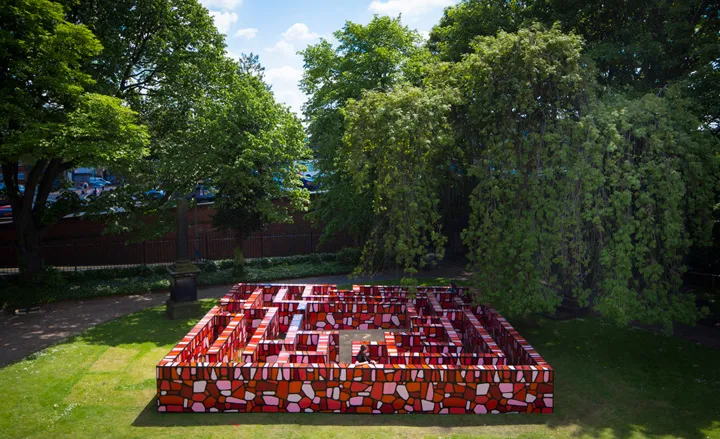
If you've ever visited the 18th-century Orangery in Wakefield, Yorkshire, it might have occurred to you that the historic grounds would be the ideal setting for a garden maze. You might not, however, have imagined the sort of maze the artist Richard Woods is unveiling this weekend in front of the Georgian folly.
Woods has always surprised with his hyper-real interpretations of ordinary façades like red brickwork and mock-Tudor cladding. True to his modus operandi, this work applies a postmodern veneer to Renaissance-era terrazzo and medieval English drystone, forcing a dialogue between the affectations of the past and the intellectualism of the present. The palette is what pushes the work into the realm of artifice.
'Colour in my work is never naturalistic,' says Woods. 'I wanted to take the drystone wall away from the real thing and into the comic world - a drawing of a drystone wall and not a real drystone wall.'
'A Maze for Yorkshire' was commissioned by the art and design charity Beam, whose offices are located in the Grade II-listed cottage. The idea developed over months of discussions with Woods, who hit the history books to devise a logical structure. He eventually finalised the scheme with the help of Neil Matthews at DLA Design Group, a project collaborator. The structure took five people two weeks to install.
Like the mazes of yore, 'A Maze for Yorkshire' amuses with unexpected turns. But like good contemporary art, it also disturbs. 'It's surprisingly difficult to navigate,' says Woods. 'Even though you can see over the top of the 4-ft walls, the repeating nature of the stone pattern trips you up and confuses your sense of direction. It's a bit of an assault on the senses, so be prepared before you set off.'

Known for his hyper-real interpretations of ordinary façades like red brickwork and mock-Tudor cladding, Woods' maze applies a postmodern veneer to Renaissance-era terrazzo and medieval English drystone

The maze was commissioned by the art and design charity Beam, whose offices are located in the Grade II-listed cottage

The four-foot walls are easily overlooked. Still, the artist says, 'the repeating nature of the stone pattern trips you up and confuses your sense of direction'

The unnatural palette pushes the work into the realm of artifice

The idea developed over months of discussions. Woods hit the history books to devise a logical structure, and eventually finalised the scheme with the help of Neil Matthews at DLA Design Group, a project collaborator
ADDRESS
The Orangery
Back Lane
Wakefield WF1 2TG