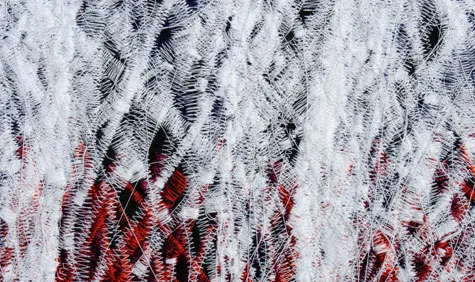
Japanese artist Tetsuo Fujimoto says his work tries to ‘make the macro and micro world coexist in one picture surface’. And to achieve this ambitious goal, he uses, of all things, a sewing machine.

See more of Fujimoto's intricate tapestries
Every one of Fujimoto’s work is created by the mechanical accretion of dense layers of stitches of coloured threads on black cloth. The process is involved and draws from a palette of 2,500 colours. Using an industrial sewing machine, he literally builds the image stitch by stitch over a period of at least two months. The tapestry is then hung up for perspective after which there is another month of adjustments to the stitch density to account for colour and luminosity.
For his first UK solo exhibition, Surface Matters: Machine Drawings, Fujimoto has created around 25 tapestries. Now, these pieces may be created by modern technology, but it’s clear they’re firmly rooted in a surrealistic tradition. The layering – a form of impasto, Fujimoto says – results in extraordinarily beguiling three-dimensional forms. The shimmering impression is not unlike staring at a mass of clouds when the perspective suddenly changes and landscapes spring into focus.
And so, Work’07-VIII brings to mind a shower of stars falling over a dense tropical jungle, while Work’07-V evokes a forest at dusk. The emotional heft of these impressions is both ethereal and yet, distinctly, Japanese – no mean feat, given the admittedly prosaic medium that Fujimoto is working with.
ADDRESS
Daiwa Foundation Japan House
13/14 Cornwall Terrace
London NW1 4QP