
Keith Haring was born on 4 May 1958 in Reading, Pennsylvania, and raised nearby in Kutztown. Captivated from an early age by Disney, Dr Seuss, and Peanuts, he turned drawing into both refuge and self-expression. By the time he moved to New York in 1978 to study at the School of Visual Arts, he had developed a distinctive visual vocabulary: bold lines, schematic forms, and shapes brimming with motion. The city’s subways, streets, and blank advertising panels became his canvas, where his energetic, instantly recognisable imagery could confront commuters directly.

Keith Haring with the Luna Luna fairground ride he designed in 1987
Art philosophy
Haring’s public presence was inseparable from his politics. He believed art should be everywhere, accessible to all, rather than locked behind museum walls or exorbitant fees. In a city devastated by the AIDS crisis, crack epidemics, social neglect, and widening inequality, his dancing bodies, radiant babies, and barking dogs conveyed both vitality and warning. He opened the Pop Shop in SoHo in 1986 to sell affordable objects with his designs, merging high art with everyday culture, while directing proceeds to children’s programs and AIDS charities. He painted murals in hospitals, playgrounds, and community centres, treating these sites as primary stages for social engagement. Activism and aesthetic were inseparable.
The tools Haring chose were as critical as the imagery itself. In the subways, he drew with white chalk on black advertising panels, allowing him to work quickly, anonymously, and directly in commuters’ paths. For murals, he favoured acrylic paint on walls, sometimes scaling compositions to cover entire façades. These materials – accessible and immediate – reinforced his ethos: art should be public and unmediated.
Collaborators

Keith Haring in the 1980s
Haring was deeply embedded in New York’s downtown creative ecosystem. He collaborated repeatedly with photographer Tseng Kwong Chi, whose portraits of his subway drawings preserved work that would otherwise have vanished. His exchanges with Jean-Michel Basquiat were rigorous aesthetic dialogue: both translated graffiti, diasporic symbolism, and street imagery into critique of race, commerce, and the art market. With Andy Warhol, Haring explored reproduction and mass culture: Warhol’s silkscreens inspired the Pop Shop, while Haring’s socially conscious urgency influenced Warhol’s late collaborations. Club 57, the Mudd Club, and the Paradise Garage were laboratories for experimentation, blending DJs, drag, performance, and visual art. Haring’s spontaneous installations and body-painting events merged spectacle with political visibility, embedding his work in the spaces his audiences inhabited.
Despite dying in 1990, aged just 31, Haring’s career was astonishingly productive. He completed over fifty public works worldwide while also making his mark in galleries. Key exhibitions include his 1982 debut at Tony Shafrazi Gallery, which introduced his subway drawings to collectors; the 1983 New York/New Wave show at MoMA PS1, which placed him alongside punk, graffiti, and performance artists; and the 1984 solo show at Mary Boone Gallery, translating street energy into the white-cube space. Posthumously, major retrospectives – including the 1997 Whitney Museum tour and the 2010 Tate Liverpool exhibition – affirm his global relevance.
Works
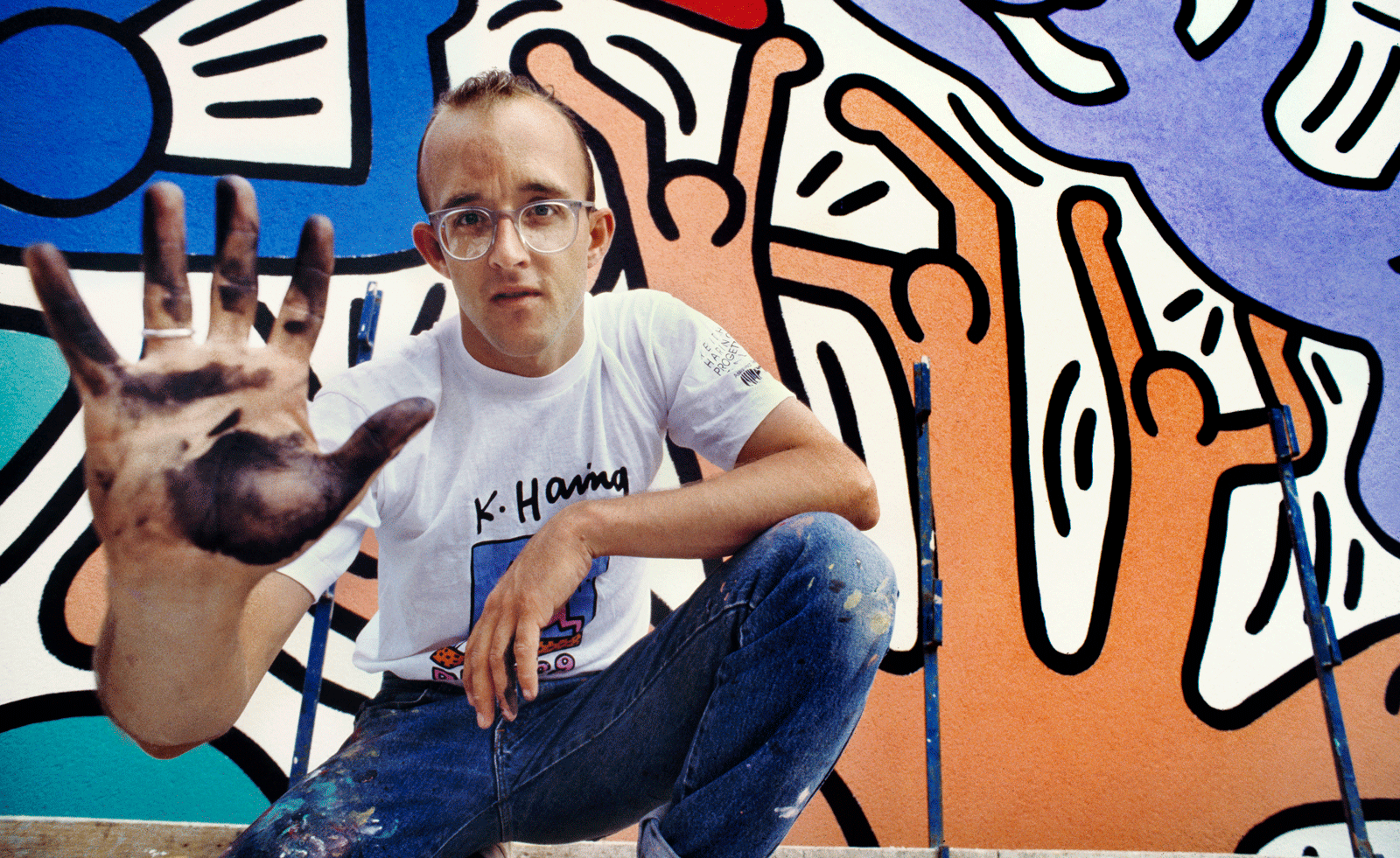
Keith Haring in the 1980s
Crack Is Wack (1986)
Painted on a Harlem handball court, Crack Is Wack is one of Haring’s most urgent civic interventions. Prompted by personal and communal concern – his assistant became addicted – it warns of drug proliferation in working-class neighbourhoods. Cartoonish figures and slashing letters make it impossible to ignore: the mural both invites and accuses, turning public space into a street-level public health announcement.
Todos Juntos Podemos Parar el SIDA (1989)
In Barcelona, Haring’s Together We Can Stop AIDS stands next to the Museu d’Art Contemporani de Barcelona in El Raval. Dancing figures, symbolic icons, and “see no evil, hear no evil, speak no evil” motifs make it both a declaration and a plea. Installed during the height of the AIDS crisis, it refuses silence and insists on visibility and care.
Tuttomondo (1989)
One of his last major public works, Tuttomondo covers the wall of Pisa’s Sant’Antonio Abate church. Thirty human and animal shapes link hands in bright primary colours, creating a vision of community and connection. Its visual harmony is tempered by awareness of fragility – Haring was dying of AIDS, and the wider world faced shifting global tensions – making it hopeful but never naive.

USA 19-82 by Keith Haring
Unfinished Painting (1989–1990)
Haring’s final work, largely blank except for clustered forms in one corner, combines human shapes, lines, and drips. Its incompleteness is deliberate: a meditation on grief, interruption, and lives cut short by the AIDS crisis and the silenced voices of those lost too soon.
Haring’s work thrives on contradiction: playful yet urgent, accessible yet politically fierce, joyous yet haunted by grief. The simplicity of his lines belied the stakes they carried. Figures that could charm commuters on subway panels also demanded attention to the realities of AIDS, addiction, and social marginalisation. This tension gives Haring’s art its pulse: celebratory and confrontational, popular yet ethically insistent.
Beyond the street and gallery, Haring rewired visual culture. He grafted graffiti onto pop art, smuggled social messages into posters, album covers, T-shirts, and tattoos, creating a visual shorthand that has been endlessly appropriated and remixed. His choice of tools – chalk, acrylic, and large-scale walls – was inseparable from this impact: fast, direct, and often temporary, reinforcing his insistence that art be immediate and unavoidable.
At the heart of Haring’s work is a refusal to look away. He made the invisible visible: illness, addiction, queer identity, and marginalised communities all demanded recognition. Flat forms, light halos, and pulse-like lines were never decorative; they were imperatives. Subway drawings said “no permission needed,” murals said “deal with it.” Haring’s legacy is not nostalgia dressed as virtue; it is a challenge: to make art immediate, inclusive, socially engaged, mischievous, and profoundly human.

Work by Keith Haring for the Montreux Jazz Festival