
In the canon of modern architecture stories, Albania stands out. It is something of a Cinderella story: a communist dictatorship which, after its fall in 1992, almost tipped into civil war. As the dust settled, people began to notice Albania – Croatia’s equally beautiful, ‘undiscovered’ neighbour – and the crowds (and investment) began to pour in, with GDP growth hovering at around four per cent in both 2024 and 2025. New development has transformed the capital, Tirana, and coastal hotspots including Durrës, Vlorë and Sarandë.
A major part of this transformation has been the recruitment of a remarkable roster of leading architectural practices, reshaping the country with a wave of modern and often highly distinctive buildings. When Wallpaper* spoke to Diogo Brito, co-founder of OODA, the architectural practice behind Tirana’s Bond Tower – a pair of kinked skyscrapers – and Hora Vertikale, comprising intriguing staggered cubic volumes, for our feature on the country’s architectural glow-up last year, he observed that ‘it is increasingly rare to find an influential architect who is not involved in Albania’.
This extraordinary influx is chronicled in Anneke Abhelakh’s new book, The Albanian Files: Freedom and Architecture, from Lars Müller Publishers. The 800-page volume documents the presence of international architecture firms in Albania since the early 2000s. Sixty practices are featured, each with its own ‘file’ combining project data and visual material with first-person reflections from the architects on their experience of working in Albania.
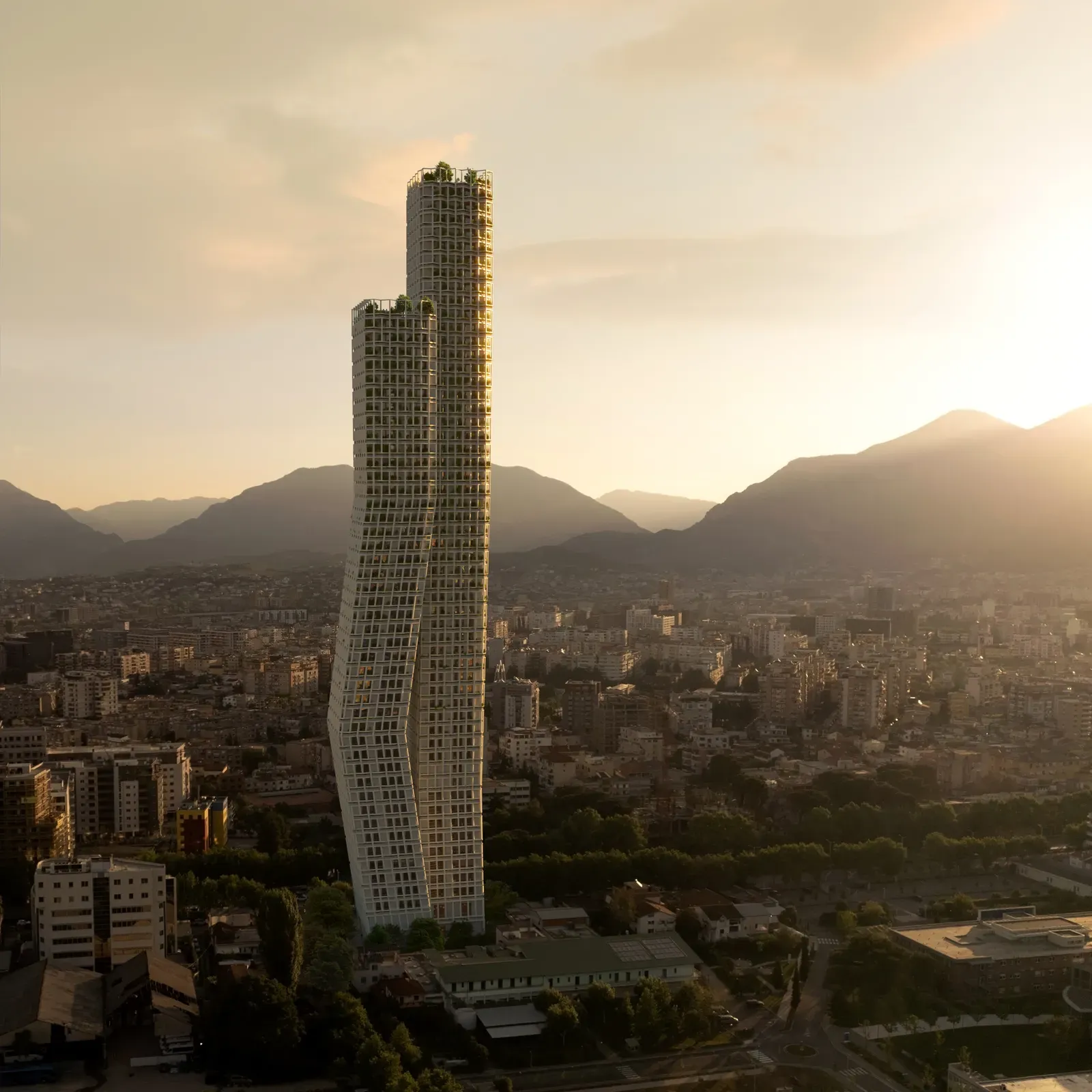
A render of Bond Tower in Tirana by OODA, an example of the bold, distinctive architecture reshaping Albania, as chronicled in The 'Albanian Files'

OODA's Hora Vertikale in Tirana
Inside 'The Albanian Files'
Stefano Boeri Architetti’s file details its role in shaping the capital through the Tirana 2030 masterplan, a city-wide green development strategy, as well as Tirana Vertical Forest, a residential tower covered with vegetation, and Blloku Cube, a boxy mixed-use building. MVRDV discusses Downtown One, a skyscraper whose ‘pixelated’ façade is meant to look like a map of Albania, and its transformation of the Pyramid of Tirana, a former communist monument, into a cultural and technology hub. Bofill Taller de Arquitectura covers, among other projects, Red Sol Resort, an eye-catching blood-red development on the Albanian Riviera.
Luca Dini Design & Architecture presents its portfolio of luxury residential and hospitality projects, including the medieval-inspired Colosseum 339, while NOA’s file features Puzzle Tirana, a tower that reinterprets Albania’s traditional pitched-roof houses.
The book also covers a series of cultural and civic projects. Bjarke Ingels Group (BIG) discusses its design for Albania’s new National Theatre in Tirana, while Kengo Kuma & Associates details the Butrint National Park Visitor Center, a gateway to the country’s UNESCO-listed archaeological site. Elsewhere, the book features projects by Herzog & de Meuron, Lina Ghotmeh Architecture and OMA, among many, many more.
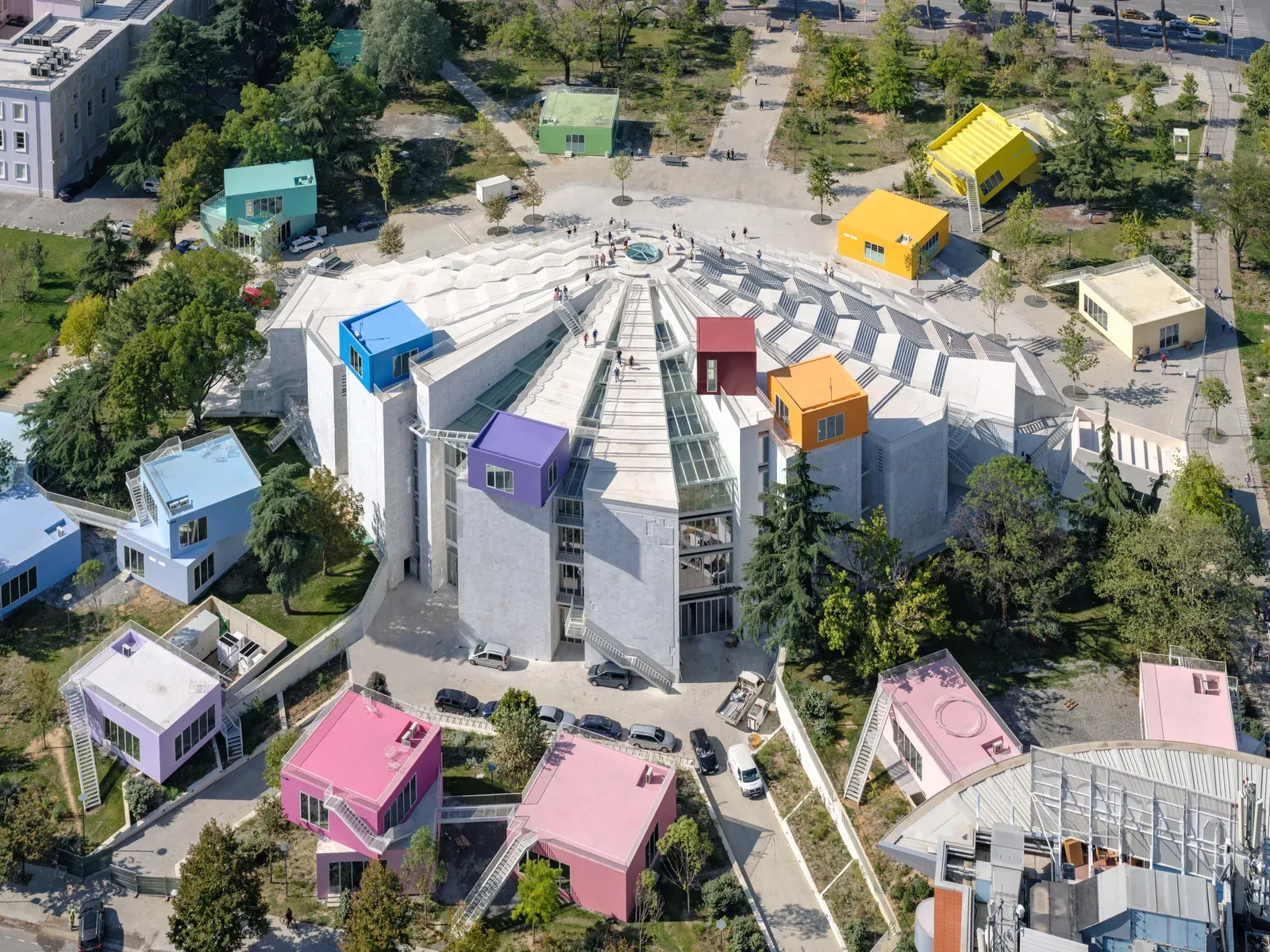
The Pyramid of Tirana, renovated by MVRDV and completed in 2023
Behind the facade
Yet Albania’s shiny new face tells only half the story. Recent internationally-broadcast protests initially focused on proposed luxury tourism developments along the southern coast, including that of Sazan Island, associated with Donald Trump’s son-in-law Jared Kushner. These have since broadened into wider discontent with prime minister Edi Rama’s government, and what critics see as its enabling of wealthy investors to gain access to valuable Albanian land.
Against this backdrop, The Albanian Files has become an unexpected flashpoint. Intended as a chronicle of Albania’s architectural transformation, the book has instead prompted questions about how that transformation has been orchestrated. Tirana Times has cast it as a revealing political document, arguing that its contributors inadvertently expose a development model based less on competitive procedures and public consultation than on direct access to the prime minister. Opponents argue that the involvement of internationally renowned architects lends the construction boom reputational legitimacy while obscuring deeper questions about who ultimately benefits.
It should be noted that the protests have a party-political dimension. Opposition leader Sali Berisha has seized on public anger by accusing Rama’s government of corruption, but Berisha – Albania’s prime minister during the turbulent 1990s – has a controversial political history of his own. The newer movement, particularly among young people and environmentalists, is better understood as generally anti-establishment, challenging Albania’s entrenched two-party system rather than simply opposing Rama.

From 'The Albanian Files': the Vlorë Beach urban development by Oppenheim Architecture
In The Albanian Files, several architects describe being contacted personally by the prime minister. Chris Precht of Studio Precht says he was first approached via an Instagram message, ‘asking if [he] would be interested in working in Albania’. Alejandro Aravena of Elemental recalls being contacted by phone by Rama, ‘asking if [Aravena] could come to Tirana to discuss the possibility of a project’, while Sam Chermayeff Office recounts a late-night call telling him that ‘“Edi” was going to call [him]’, after which ‘[his firm was] asked to do two projects in Tirana’.
Elsewhere, an open letter to Rama by OMA’s Reinier de Graaf satirically muses that ‘...our profession would benefit greatly if the country never had another election again, and if you… would just continue as president for life – maybe even King’. The prime minister, who wrote the book’s foreword, has defended the passage as obvious irony. But in a country marked by memories of dictatorship, the joke has proved contentious.
Writer and activist Fatos Lubonja has helped organise a group of around 600 people scrutinising the book, with lawyers reportedly preparing a complaint to Albania’s Special Anti-Corruption Structure (SPAK). Separately, citizens protesting a planned investment in the Zvërnec area have also submitted the book to SPAK.

From 'The Albanian Files': view of Skanderbeg Square, reimagined by 51N4E
Albania’s transformation is both remarkable and complex. The arrival of some of the world’s leading practices has given the country a new identity, while the scale and speed of development have raised wider questions about planning and power. Abhelakh’s chronicle is a valuable record of a country undergoing profound physical change, but it also reveals that its architectural story is about more than striking buildings: it is about who gets to decide what Albania’s future looks like.
