Traditional methods underpin Smiljan Radic's designs: 'I am not a creator of new shapes'
Smiljan Radic is building a reputation with fabric roofs, fake ruins and a supporting cast of boulders; we visit a story from the Wallpaper* archives, exploring the architect's work, from a Chilean winery to London’s 2014 Serpentine Pavilion


'I am not a creator of new shapes,’ says Chilean architect Smiljan Radic, when asked about his design approach. It’s true that, if anything, Radic’s work, created using modern as well as natural and traditional materials and techniques, can feel at times strangely familiar. He works a lot with existing architectural and historical narratives and references, which he plays with and reappropriates. ‘I always want to begin from a project that I thought about or saw before, or existing sketches, or architectural history.’

Smiljan Radic
Explore the work of Chilean architect Smiljan Radic
Radic’s new design for the Serpentine Pavilion in London is nothing like the gallery’s architecture programme has ever seen before. Featuring a translucent ring of glass-reinforced plastic, sitting on solid rocks, a reference to a modern-day Neolithic dolmen wouldn’t feel amiss.
This is only the architect’s second building outside his home country (Radic took part in the Austrian bus stops project featured in W*183). The Serpentine Pavilion is also one of Britain’s most awaited summer commissions, assigned each year to an architect who hasn’t built in the UK before.

Smiljan Radic’s 2014 Serpentine Pavilion
It all started a few months ago, when Serpentine co-director Julia Peyton-Jones was travelling through South America for research. She met Radic in November 2013, and in early December, the architect received a call announcing that he’d been selected for the commission. ‘There’s something of an architectural explosion happening in Chile right now, and Smiljan is one of the most interesting architects working there today,’ says Peyton-Jones. ‘Crucially, Smiljan brilliantly adapts his style and use of materials to every setting.’
For this project, Radic decided to play with the idea of the folly, referencing Japanese temples and using large rocks as foundations. ‘Follies have been used historically in gardens and parks to propose something extravagant,’ he says. ‘This is a fake ruin, but at the same time, it proposes a continuity. Rocks are often used as decoration, but here they’re the real foundation of the volume. You may initially think that this is part of the park, but it’s really part of the building. It helps dissolve the limits between architecture and nature.’
I am not a creator of new shapes
Smiljan Radic
The pavilion will act as a café, resting and meeting space, as well as a multi-use platform for events, although these functions were not the ‘key’ to the design solution, says Radic. ‘In the end, the commission is about creating a symbolic place,’ he says. ‘The design and the ambience around the site are more powerful than the function. It’s about thinking about small-scale and global architecture, and opening up a discussion.’
One of the first projects that brought Radic to international attention was his Mestizo restaurant in Santiago, completed in 2007. It uses similar, large, solid rocks to support its roof. He’s also completed several private houses (including his own in Santiago), which experiment with local construction techniques and different materials, from concrete and stone to fabric, earth and copper. A sculptural entry into the 2010 Venice Architecture Biennale, curated by Kazuyo Sejima, made of granite stone and perfumed cedar wood, and created with Radic’s wife, artist Marcela Correa, drew further attention to the architect’s unconventional work, which balances the minimal, the fantastical and the everyday.
His approach, he says, isn’t about form. It’s not even about materials, although he admits he likes playing with the ordinary and the ephemeral. The final shape of a structure comes second to the methods used in construction. He learned this while working in Chile, where he feels the many opportunities for self-building allow scope for architects to do things differently.

Glass-reinforced plastic shell castings at the North Yorkshire workshop of the engineering firm Stage One
This year is a key one for Radic. He’s just won a competition to design a telecommunications tower in Chile and completed an extension for the Chilean Museum of Pre-Colombian Art in Santiago. He’s also about to complete a winery project for Vik Retreats, some 200km south of Santiago, in Millahue. The commission went to Radic (as well as architect Loreto Lyon) after a countrywide competition in 2007. Radic then spent a further three years refining the winning design.
The client wanted to work with a Chilean architect, and Radic’s solution spoke to their overall vision. ‘It was important that the winery be integrated into the landscape, while also creating something that was pleasing, unique and innovative,’ say Vik Retreats owners Alexander and Carrie Vik.
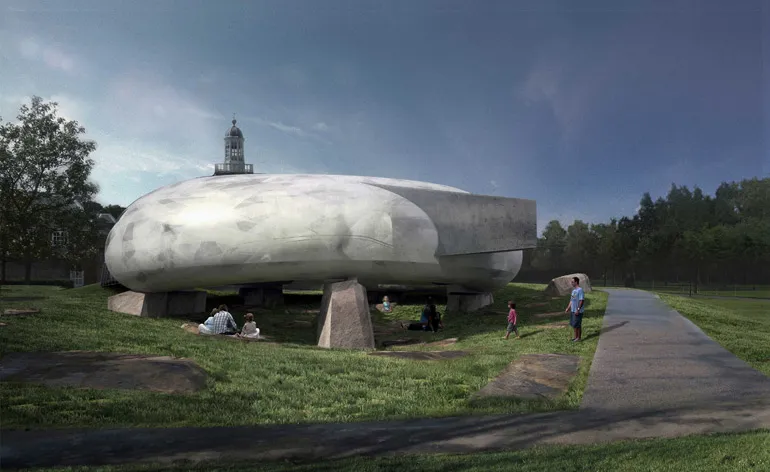
Visualisation of Smiljan Radic's semi-translucent pavilion for the Serpentine Gallery
Set among rolling hills and sweeping valleys with the Andes in the distance, the winery stands out with a 130m x 40m fabric roof, which filters natural light into the building. The low structure makes use of a variety of surfaces and textures on ground level, while the main facilities are placed below ground, where the winery unfolds, and the barrels are kept.
This is a design that aims to be sustainable and eco-friendly. The light entering through the fabric roof is enough for the interior to operate without artificial lighting, and a ground-level water feature is instrumental in the underground level’s natural cooling. The approach is emblematic of Radic’s design: smartly used, simple, everyday elements elevated to create sublime spaces.
A version of this story was first published in Wallpaper* July 2014
