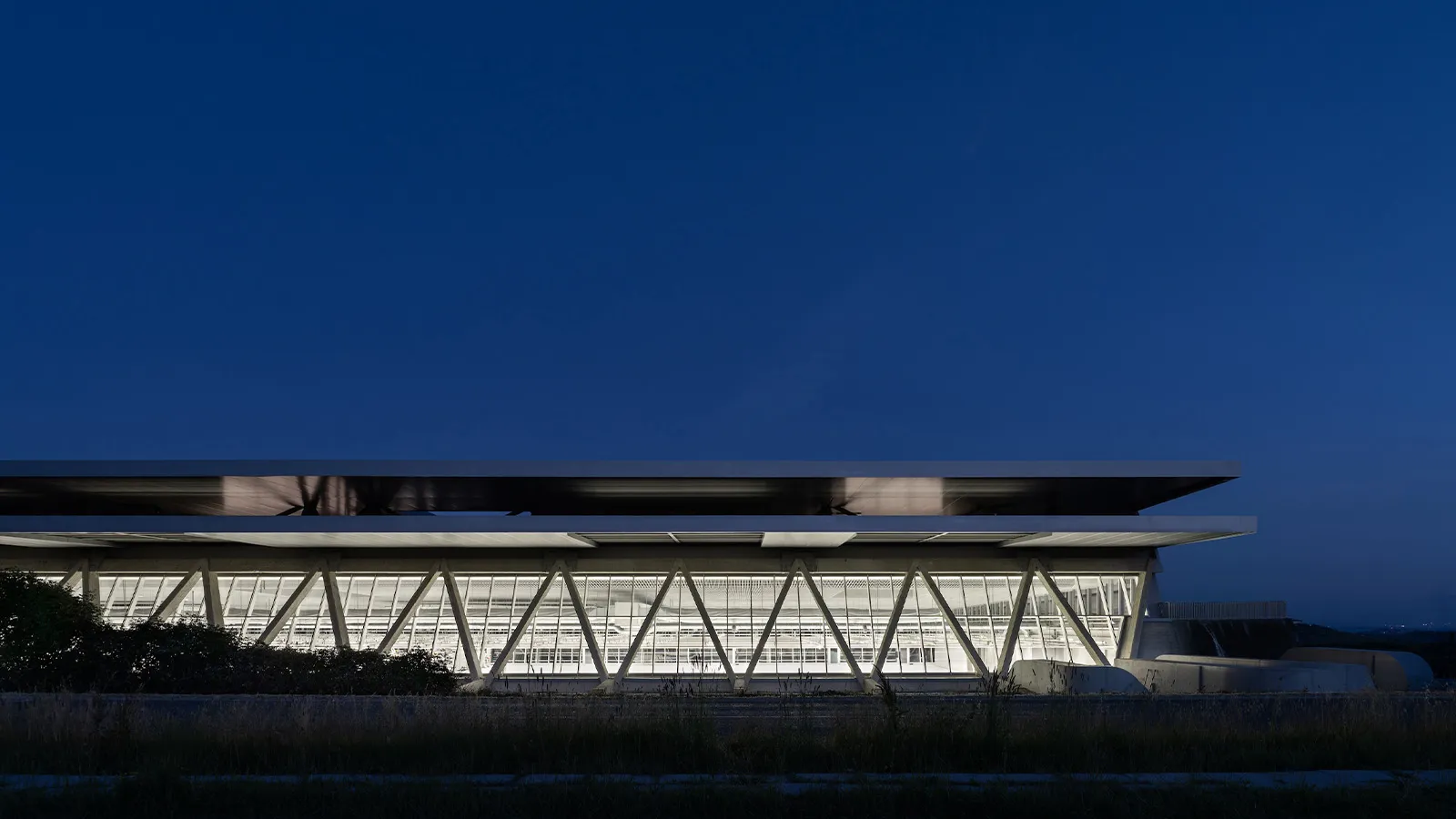
Balenciaga has unveiled its new leather goods factory in the heart of Tuscany, which enabled its first in-house production in Italy. Titled ‘The Plant’, the luxury house's production hub was built on one core principle: regeneration. The project was led by Metrooffice Architetti, an architectural firm based in Florence, and represents the reuse and adaptation of an existing industrial complex.
Inside The Plant, Balenciaga's new production factory

Located in the village of Cerreto Guidi (in the countryside west of Florence), the former Enny leather factory was founded in the 1960s by Giovanni Battista Cappellini, a leading figure in post-war Tuscan entrepreneurship. The factory was known for crafting leather handbags, which were shipped across Italy and abroad.

As production declined, the factory – comprising three key elements, built between the 1960s and 1980s – was abandoned. For Balenciaga, Metrooffice founders Fabio Barluzzi and Barbara Ponticelli embraced the chance to breathe new life into the site.

The architects worked closely with the client to highlight its history, make design choices based on sustainable reuse where possible, and create a cohesive architectural language.

They restored the exposed reinforced concrete, which remains as a gentle nod to the past, and installed a new roof, composed of two superimposed slabs, replacing an excessively high original. The complex now feels lighter and less jarring against the Tuscan landscape, its series of horizontal planes making it appear to be ‘suspended among the olive trees’, according to the architects.

The first part of the building to be developed was turned into a training centre, and is home to open-plan workspace, with a cutting area, as well as offices.

The renovation of the main plant followed, the heart of the whole project, which unfolds over several levels. The basement offers parking, while the entrance level hosts the reception, offices, an auditorium, storage areas, changing rooms, and a cutting department.


The next level is dedicated entirely to production and comprises a large, open space free of internal columns. Above this, a glazed lobby leads to a garden and the training centre. A connecting structure known as ‘The Bridge’ has been redesigned to accommodate the canteen and kitchen facilities.


New material choices reflect the project’s contemporary vision. Exposed concrete, grey resin floors, glass and aluminium are complemented by visible technical systems and acoustic panels that define the space.

The Plant is designed to evolve over time, paying ode to the site’s history while starting a new chapter.