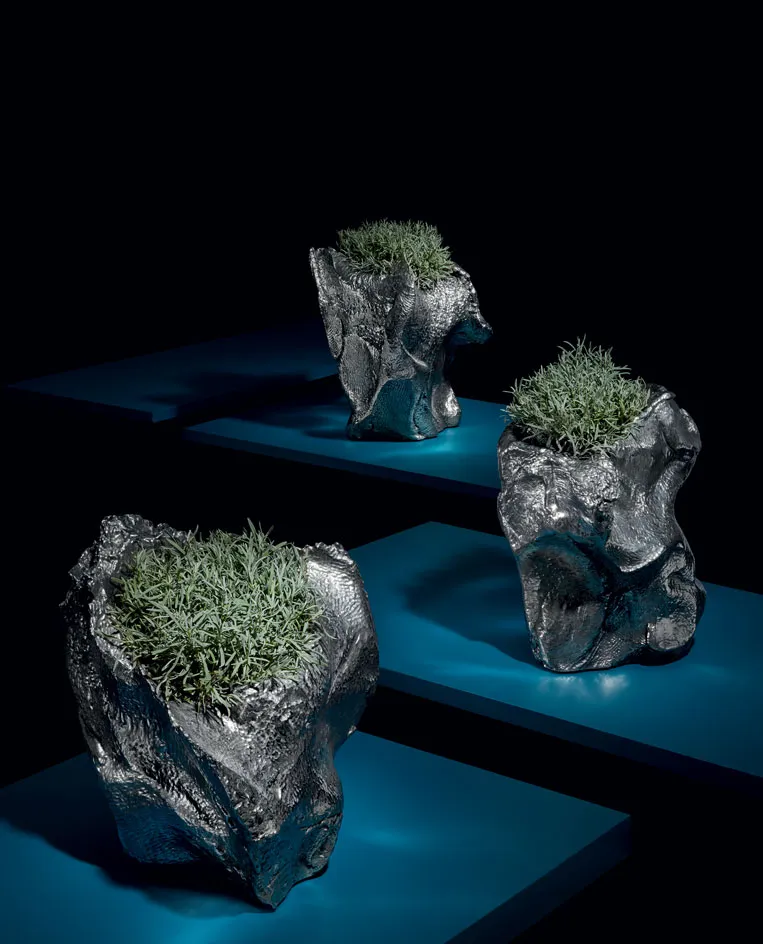
Master cast: we’re reviving our landscape with Fredrikson Stallard’s graphic bronze planters
London design duo Fredrikson Stallard have mastered the art of making complex processes look seemingly effortless. Their latest work, a line of monolithic vessels, is no different. Designed to hold plants, both indoors and out, the sculptural ‘Hybridae’ series is made by moulding objects in terracotta, then digitally enlarging them into permanent pieces cast in solid white bronze. The precise process ensures every detail, including fingerprints and traces of machinery, are meticulously captured and magnified in the final shimmering works.
As originally featured in the May 2017 issue of Wallpaper* (W*218)
Hybrideae IV’ and its creators, Patrik Fredrikson and Ian Stallard
’Hybrideae IV’ and its creators, Patrik Fredrikson and Ian Stallard
The Hybrideae series is the result of shaping minute expressive objects in soft red terracotta and then digitally enlarging these into permanent objects in white bronze
The designers working on the finishing touches of ’Hybrideae IV’
INFORMATION
For more information, visit the Fredrikson Stallard website
Receive our daily digest of inspiration, escapism and design stories from around the world direct to your inbox.
Ali Morris is a UK-based editor, writer and creative consultant specialising in design, interiors and architecture. In her 16 years as a design writer, Ali has travelled the world, crafting articles about creative projects, products, places and people for titles such as Dezeen, Wallpaper* and Kinfolk.
-
This cult Los Angeles pop-up restaurant now has a permanent addressChef Brian Baik’s Corridor 109 makes its permanent debut in Melrose Hill. No surprise, it's now one of the hardest tables in town to book
-
French bistro restaurant Maset channels the ease of the Mediterranean in LondonThis Marylebone restaurant is shaped by the coastal flavours, materials and rhythms of southern France
-
How ethical is Google Street View, asks Jon Rafman in CopenhagenIn 'Report a Concern - the Nine Eyes Archives' at Louisiana Museum of Art, Copenhagen, Jon Rafman considers technology's existential implications