Easily one of the most highly anticipated art exhibitions of the season, the Whitney Museum of American Art’s Frank Stella survey, which opened this week in New York, began with a simple curatorial question: What major artist hasn’t had a major retrospective in a long time? 'The surprising answer, among others, was Frank Stella,' said Michael Auping, the chief curator at the Modern Art Museum of Fort Worth, who helped organise the show, as he addressed a drove of journalists on a drizzly Wednesday morning.
The exhibition, titled 'Frank Stella: A Retrospective,' is on view at the Whitney through February before it heads to the Modern Art Museum of Fort Worth the following summer, and then to the de Young Museum in San Francisco. The exhibition, designed by starchitect Annabelle Seldorf, spans the entire length of Stella’s career (six decades) putting together approximately 100 works, some which the world has had the pleasure of viewing in major museums, and others that have been tucked away in private collections for many years.
One thing the curators brought up repeatedly was Stella’s ability to reinvent himself — and his work — throughout his life, and that is evident through the pieces seen in the Whitney’s galleries. The retrospective opens with two works that demonstrate Stella’s Scope; on one side is Pratfall, a simple 1974 painting that depicts a number of squares to make the viewer feel as if they are falling down a hole. Next to it is Das Erdbeben in Chili, a large scale 1999 piece that is chaotic as its name (Erdbeben means earthquake in German) implies; different patterns and shapes and colors collide with one another.
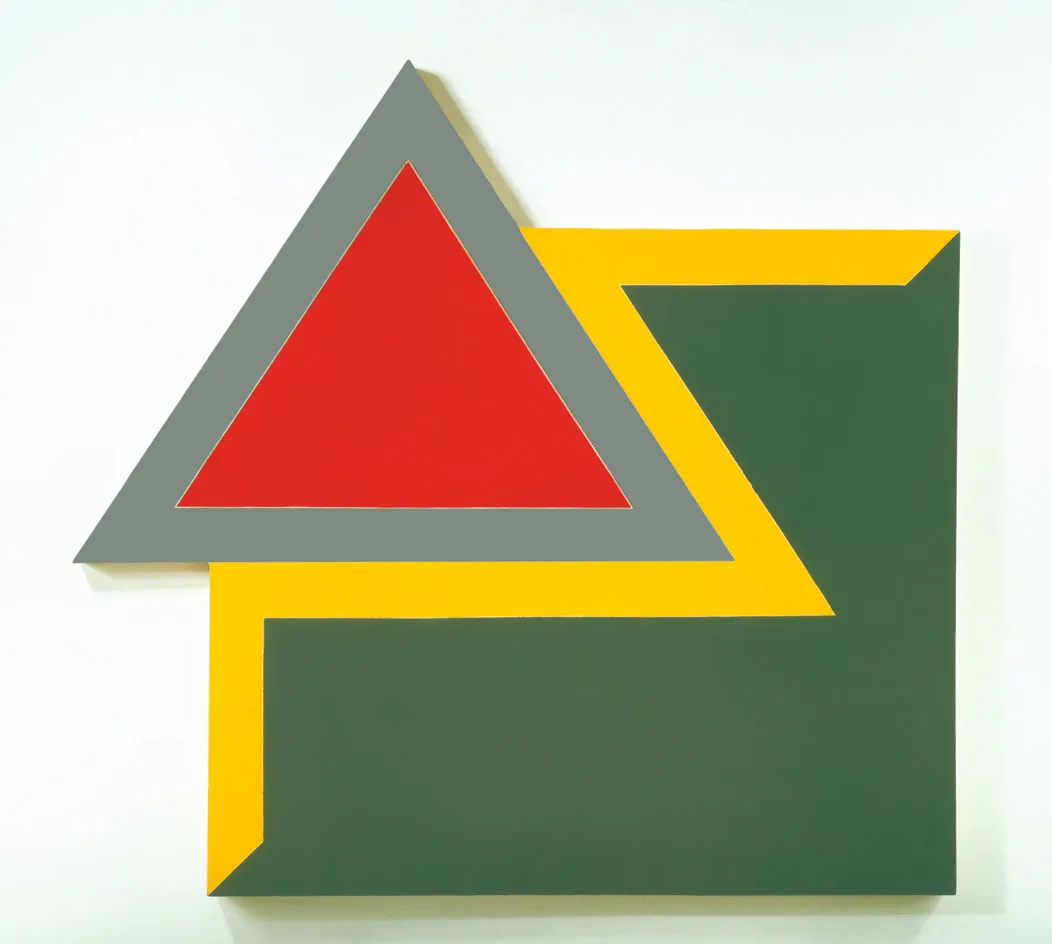
Also included are Stella’s minimal classics, like Harran II, a vivid piece from 1967 that puts together a series of curves, and the 1966 painting Chocorua IV, which is made up of four colours — red, grey, yellow and green — and consists of a triangle drawn over a square. Rarely-seen treats, like a selection of drawings from the ‘50s and ‘60s are also on display, as are a series of maquettes of his more recent, enormous sculptures. As Stella evolves an artist, there’s no denying that his newer work becomes more complex and elaborate.
Although Stella wasn’t present that morning — he was apparently napping, and at 70, that isn’t a surprise — Adam Weinberg, the director of the Whitney, did bring up a quote that explained Stella’s personality in one phrase through an interview with art historian Caroline Jones, which also appears as one of the wall texts:
Q: Where do you stand on 'purity'?
A: I don’t know. Wherever I happen to be.
'Classic Frank,' Weinerg says. 'Totally evasive.'

The exhibition is designed by Annabel Selldorf and will travel to the Modern Art Museum of Fort Worth the following summer, and then to the de Young Museum in San Francisco. Pictured: Gobba, zoppa e collotorto, 1985. Oil, urethane enamel, fluorescent alkyd, acrylic, and printing ink on etched magnesium and aluminum

One palpable aspect of the show is Stella’s ability to reinvent himself and his work throughout his life. Pictured: East Broadway, 1958. Oil on canvas

Stella's evolution as an artist is reflected in his more recent work being increasingly elaborate and complex. Pictured: Grajau I, 1975. Paint and laquer on aluminum

'Frank Stella: A Retrospective' charts the artist's career over six decades. Pictured: The Whiteness of the Whale (IRS-1, 2X), 1987. Paint on aluminum

Plant City, 1963. Zinc chromate on canvas
INFORMATION
’Frank Stella: A Retrospective,’ opens on 30 October and will run until 7 February 2016
Photography: Courtesy of the artist and Whitney Museum of American Art
Address
Whitney Museum of American Art
99 Gansevoort Street
New York