Singaporeans like to joke that there are only three things to do in Singapore: eat, shop and watch a movie. Any other kind of physical activity is studiously avoided on the pretext that it's too hot to do much more than walk very slowly from one air-conditioned mall to the other.
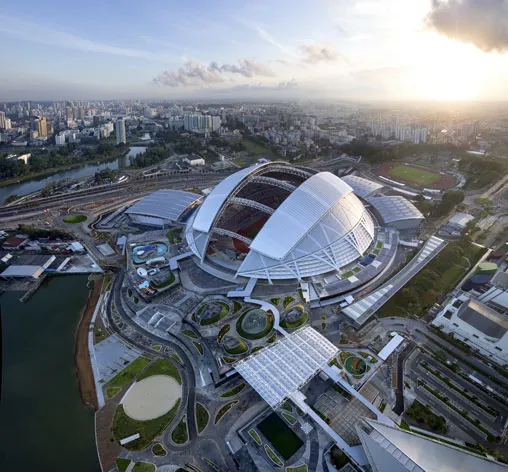
That said, the recent opening of the mammoth Sports Hub on the edge of the Kallang River should be enough to coax even the most reluctant residents out for some fresh air. Built on the site of the former Singapore National Stadium, the S$1.3bn complex dwarves Japanese architect Kenzo Tange's neighbouring Singapore Indoor Stadium on a scale that makes it visible for miles in every direction.
Arup sports architecture practice and Singapore-based firm DP Architects led a global team of engineers and designers that carried out this extraordinarily ambitious project. The 35-ha waterfront site presented many challenges, the biggest of which was its footprint, but the result is a network of facilities and complex infrastructures that fit together as a surprisingly harmonious, tessellated whole.
Dominating the complex is the new 55,000-seat National Stadium, a curvaceous shell with a retractable scarab-like roof. The dome spans 310m making it not just the largest spanning dome in the world, but also the world's first stadium with the capability to host athletics, football, rugby and cricket games all in one venue, converting from one field to the next (with adjustable seating) within 48 hours.
Abutting the stadium is the 3,000-seat OCBC Aquatic Centre, which houses three pools for competition, training and diving; the Water Sports Centre for elite training and racing; jogging path and fitness areas; the Sports Hub Library & Singapore Sports Museum; and, this being Singapore, a 41,000 sq ft water park complex of retail, food and beverage outlets.
Additionally, environmental concerns were incorporated into the infrastructure, including low energy, natural ventilation systems, a wetland feature, and bioswale filters that clean surface runoff water.
For a country that has, until now, lacked a comprehensive set of modern sporting facilities, the Sports Hub is proof enough that keeping fit is no longer a laughing matter.

Built on the site of the former Singapore National Stadium, the S$1.3bn complex includes the new 55,000-seat National Stadium, complete with a retractable scarab-like roof.

The dome spans 310 metres, making it the widest globally. It is also the world's first stadium with the capability to host athletics, football, rugby and cricket games all in one venue.

Next to the stadium is the 3,000-seat OCBC Aquatic Centre.

The Aquatics Centre houses three pools for competition, training and diving.

A separate pool has been dedicated to the local community.

The complex also includes the Sports Hub Library, Singapore Sports Museum, a jogging path and various fitness areas.

A waterpark complex of retail, food and beverage outlets completes the entertainment hub.
ADDRESS
Singapore Sports Hub
2 Stadium Walk, Singapore 397718