Have the cities' red-light district turned green?

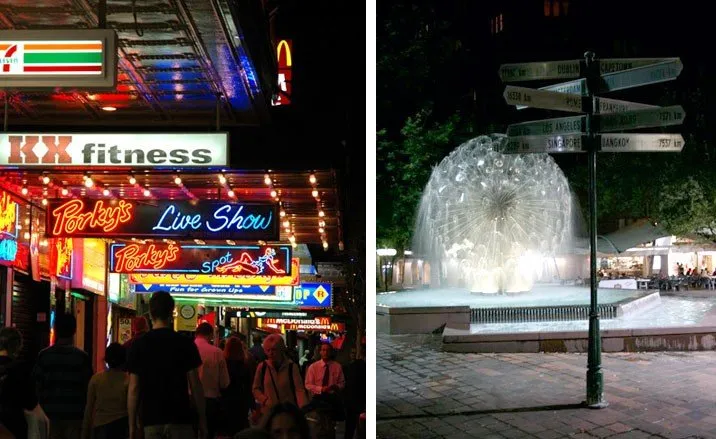
Sydney (scroll down to read more)
Kings Cross, Sydney’s red-light district started out as an urban bohemia in the 1930s: home to artists, writers, actors and, later, hippies and soldiers on rec leave from Vietnam looking to relieve their tensions.
It wasn’t what you’d call a middle-class idyll, but by the 1990s it had changed again. Illegal casinos, bent cops, hookers, hard drugs, strip clubs and crime lords turned the neighbourhood into a more sinister proposition. Then, as the new millennium arrived, so did the changes.
Successive Lord Mayors, Lucy Turnbull and Clover Moore, pushed for a cleaner Cross. There was a $15 million facelift, regulation of the sex industry and a stronger police presence (a Royal Commission into corruption in the mid-1990s had purged the force). Even the strip club spruikers were told to get some manners or face banishment. A string of bars and clubs appeared, while legendary trouble spots closed. Apartment prices sky-rocketed and the traditional residents have been forced further into the suburbs. While some applaud, others are sure that a part of Sydney’s identity has been lost forever.
Writer Carrie Hutchinson

Amsterdam (scroll down to read more)
Amsterdam pretty much invented the idea of the global hub, attracting travellers and traders since the 17th century. They all found swift satisfaction in the local ‘houses of pleasure’, which the city has been trying to manage ever since.
Prostitution was finally legalised in 2000, but more recently city authorities have become concerned that the local small-scale sex industry has been replaced by the more brutal business practices of international gangs. Over the last couple of years, the city has worked with a local housing corporation to buy up some of the 17th-century buildings that still house the window brothels of the red light district, known as De Wallen. It wants to put them to other uses by adding bookshops, cafes, galleries and other more refined cultural and commercial draws to the relentless parade of knocking shops.
The city aims to reduce the number of window brothels and find a better balance of the chic and the shady. The Redlight Fashion Amsterdam initiative is part of this creative re-use of the window brothels and has installed 19 designers and two fashion photographers in the workspaces once used by prostitutes – with tiled beds and strip lighting intact.
Originally designed as a year-long experiment, the project has already been extended once and is awaiting news of a further extension. It has also encouraged similar projects called Redlight Design and Redlight Art. Karlijn Bozon of HTNK, a fashion recruitment and consultancy behind the Redlight Fashion initiative, insists that it isn’t planning on forcing the working girls out of the area completely: ‘We want to keep the area raw and exciting.’
Writer: Alex Onderwater

El Raval, Barcelona (scroll down to read more)
Were Jean Genet, the French writer and connoisseur of low-life, to land in El Raval today, he would recognise little of the world of vagabonds, flea-bitten bordellos, transsexual prostitutes and rent boys he portrays in his 1949 work ‘A Thief’s Journal’ (though he may be chuffed to find a square now named after him).
Once the biggest red-light district in Europe, El Raval (which translates from the Arabic as ‘an area outside the walls’) has seen the most aggressive of the city’s urbanisation projects over the last decade: whole swathes of dank apartment blocks were bulldozed, making way for new plazas and boulevards and space for museums and hotels.
But venture below the Carrer Hospital to the lower portside streets of El Raval and a very different panorama unfolds. Dubbed Barrio Chino (or ‘Chinatown’) in the 1940s in a reference to the less salubrious districts of US cities, sex workers still gather by the dozen in the dark shadows of its narrow streets. Unlike Genet’s days, when El Raval was a magnet for the under-classes from other parts of Spain, these days the girls come mainly from West Africa and the old Eastern block. It’s not ancient stonewalls anymore that separate them from the city proper, but the barricades of EU immigration laws.
Writer: Suzanne Wales

Singapore (scroll down to read more)
The legend of the prim, bespectacled librarian who cuts loose after hours might well have been invented by Singapore. Scratch a little and you’ll find a city that is remarkably more relaxed on sexual matters than its lacquered exterior might suggest.
From the 1950s until well into the 1980s, the Bugis area lured sailors and tourists alike with a colourful mix of leggy transvestite and transsexual prostitutes. Director Peter Bogdanovich immortalised the district with Saint Jack, and for his efforts, the movie was banned for decades. After the government’s determined efforts to turf out the hookers in the late 1980s, the action has shifted towards Orchard Towers (the infamous ‘Four Floors of Whores’), Keong Saik Road, Desker Road and Geylang.
Local residents protest against the traffic of customers cruising the gaudily made-up streetwalkers – but since prostitution is legal, the pragmatic authorities smile tightly and look the other way.
Daven Wu
Hamburg (scroll down to read more)
Prostitution was actually legalised in Germany in 2001, but many of the country’s cities have long turned a blind eye, including Hamburg. Here the St Pauli red-light district – a labyrinth of streets that run off the Reeperbahn down to the city’s docks - was once lined with strip clubs and bars promising live sex shows. But St Pauli’s sex-based economy is today in its death throes.
In the 1980s, there were more than 1,000 prostitutes in the area, many working in the notorious six-storey Eros brothel, which closed its doors in 1988. Now there are thought to be only 400 still working in St Pauli, and the numbers are in steep decline. Last year, Hotel Luxor, the area’s last remaining brothel, famous for its neon promise of ‘pretty women for happy nights’, finally closed its doors.
Waltraud Mehrer, Luxor’s madame of 21 years, blames the internet and the popularity of call girls. Others blame the arrival of discos catering to teenagers only interested in binge drinking and property developers who want to make the area safe for high-end apartments and ad agency offices.
The longer-term decline of the area has more to do with the mechanisation of modern logistics: cargo ships have long since stopped disgorging crews of sex-starved sailors into St Pauli. But all these changes have not gone unchallenged: 200 local entrepreneurs are today leading a resistance movement.
Joachim Bessing

London (scroll down to read more)
Despite having held a reputation as London’s lascivious centre for the past few decades – the sexual inhabitation of Kings Cross actually occurred at the turn of the last century, a moment when Victorian London loosened its corset, breathed a sigh of relief, and put sex back on the agenda.
Although the red-light district endured the tumultuous first half of the century, the 1970s sent a wave of immorality across the capital, putting Kings Cross on a bullet train to Barbarism. With tales of alfresco intercourse, back-alley solicitations and ankle-injecting hobos reaching the press, Kings Cross became a breeding ground for struggling artists, vagrants and itinerant intellects.
Now however, due to a mid-90s government directive, the Cross has begun to clean up its act. With the opening of the St Pancras International Eurostar terminal the area has attracted some big name institutions looking to take root, including The Guardian and the University of the Arts. In addition (following a £250m cash injection) Kings Cross Central is set to welcome a heady selection of markets and boutiques, 2,000 residential plots and 5 million sq ft of office space. These days, those with more licentious dispositions are probably better off heading north to Camden, south to Vauxhall, or of course, the bright lights and dropped tights of Soho are only ever a few stops on the tube away.
Writer: Teo van den Broeke

Bangkok (scroll down to read more)
Few cities fuse high culture and sex as seamlessly as Bangkok. Like a well-edited concept boutique, the city is divided according to demographics and sexual preferences. Patpong attracts tourists for its tiger shows involving ping-pong balls, darts and cigarettes; expatriates prefer Nana Plaza and Soi Cowboy for their fix of rough trade and lesbian action; wealthy Thais and Japanese frequent cocktail bars along Ratchadapisek Road, while Silom Soi 2 remains Bangkok’s gay epicentre.
Every so often, the government tries to clean things up. The previous prime minister, Thaksin Shinawatra, unleashed his deputy on the job, but his greatest success was to force bars to close by 2am. These days, it’s business as usual.
As one long-time expat resident observes, ‘They’ll never clean it up. The sex trade is too much a part of Thai culture, and besides, it brings in much-needed cash.’
Writer:Daven Wu

Tokyo (scroll down to read more)
For most of the Noughties, Tokyoites looking for titillation were spending big on what amounted to simulated flirting. Bars charged men and, notably, women ¥100,000 to drink Cristal with a hostess or host while engaging in suggestive idle banter.
But there was a seedier side too, and Tokyo Governor Shintaro Ishihara decided to crack down on Shinjuku’s Kabukicho red-light district, digging up an old law that let him close hostess clubs between 1am and 7am. Club profits nosedived and workers took to street corners.
But across town, girls have found a new way to make coquetry pay. ‘Garçon to Issho’ in downtown Akihabara offers guided tours of the city run by girls dressed as boy butlers. For ¥6,000 per hour, a besuited boy-girl will take you by the hand and lead you on a tour of Tokyo. Some even have specialty subjects – there’s an arty garçon, a gadget garçon – even a darts garçon. Beats a drunken tete-a-tete any day.
Writer: GORDON KANKI KNIGHT
